

Advertise with us

3D GRAPHY NEWS

  • Home
  • Interviews
    • Text Interviews
    • video Interviews
  • R & D
  • Spotlight
    • Spotlight Text
    • Spotlight Videos
  • Medical
    • Medical Devices
    • Orthotics & Prosthetics
    • Pharma
    • Cardiology
    • Head & Neck
    • Neurology
    • Orthopaedics & Spine
    • Ayurveda
  • Dental
  • Engineering
    • Aerospace & Defence
    • Architecture & Construction
    • Marine & shipbuilding
    • Automotive
    • Energy
    • Heavy Industry
  • 3D Technologies
    • 3D Printing
    • 3D Scanning
    • 3D Software
    • 3D Simulation
    • 3D Design
    • 3D Visualisation
    • 3D Digital Twin
    • Artificial Intelligence
  • Materials
  • LifeStyle
    • Jewellery & Fashion
    • Gadgets
    • Pharma & Food
    • Art & Entertainment
  • About Us
    • About Us
    • Editors Desk
    • 3D Expert Desk
    • End users desk
    • Advertise with us
    • contact-us
  • News & Events
First ads
Second ads
Home» 3D Printing»Hyundai and Kia tout 3D printing as a way to accelerate product development
Screenshot

Hyundai and Kia tout 3D printing as a way to accelerate product development

Dr. Shibu John Fri Aug 2026 3D Printing, 3D Technologies, Automotive, News & Events, R & D Leave a comment 154 Views

Facebook Twitter linkedin Pinterest WhatsAppt Telegram Viber More

Hyundai Motor and Kia say they’re expanding “design freedom” beyond the constraints of conventional manufacturing via “a commitment to engineering excellence,” in part through industrial 3D printing.

“Engineers are utilizing advanced industrial 3D printing to compress development timelines and print complex components from digital blueprints,” the release states. “For decades, automotive design has been constrained by the limits of the factory floor. If a part could not be injection-molded, die-cast, or carved from raw materials, it simply could not be built. Engineers had to compromise on components’ weight, geometry, and performance to fit existing equipment and processes, as developing custom molds and machines would be too time-consuming and costly.”

But the automakers say that the AMSC at Hyundai Motor and Kia’s Namyang Research and Development (R&D) Center “flips this paradigm.”

This is because components move from digital design to “fabricated reality” through advanced additive manufacturing technologies including laser-melted metals to powder-sintered polymers, with reduced tooling requirements and greater material flexibility, according to the release.

“Engineers can design for optimal weight and performance and manufacture complex geometries that are difficult to achieve through conventional methods,” the release states. “Traditional manufacturing relies on molds, dies, and subtractive processes — shaping material by removing excess. This approach limits design flexibility, extends development timelines, and generates material waste.

“In contrast, additive manufacturing (3D printing) involves precisely layering material to build the exact geometry specified in digital designs. For vehicle development, this enables rapid prototyping as well as complex geometries and weight optimization that are difficult to achieve through traditional methods.”

A sample metal component after partial CNC machining, demonstrating post-processing of an additively manufactured part. (Provided by Hyundai/Kia)

Hyundai and Kia state that the AMSC operates a range of additive manufacturing technologies tailored to different materials, geometries, and performance requirements.

“Depending on the application, engineers can utilize both polymer- and metal-based manufacturing processes to achieve production-grade performance and precision,” the release states. “For polymer applications, the center employs Vat Photopolymerization technologies, including Digital Light Processing (DLP), which uses ultraviolet light to cure entire layers of resin simultaneously, and Stereolithography Apparatus (SLA), which traces intricate geometries with precision-guided lasers. These technologies are particularly well suited for highly detailed components used in design validation, prototype development, and other applications requiring fine dimensional accuracy.”

It adds that the AMSC also operates Polymer Powder Bed Fusion (Polymer PBF) systems. Powdered polymer materials are fused layer by layer, bypassing the need for support structures and minimizing material waste and post-processing requirements, according to the release.

“After vapor-smoothing treatment, components can achieve surface finishes comparable to injection-molded parts, making the technology suitable for high-quality customized and development components,” the release states.

“For metal applications, Metal Powder Bed Fusion (Metal PBF) systems use high-energy lasers to melt metal powders into highly complex geometries. The process provides the dimensional accuracy and mechanical performance required for advanced vehicle components while enabling designs that would be difficult to achieve through casting, stamping, or machining.”

Another methodology is Directed Energy Deposition (DED), which is used for larger-scale metal components. A use example is DED-Wire Arc Additive Manufacturing (DED-WAAM) — welding-arc technology deposits metal layer by layer and is compatible with steel, stainless steel, aluminum, and titanium.

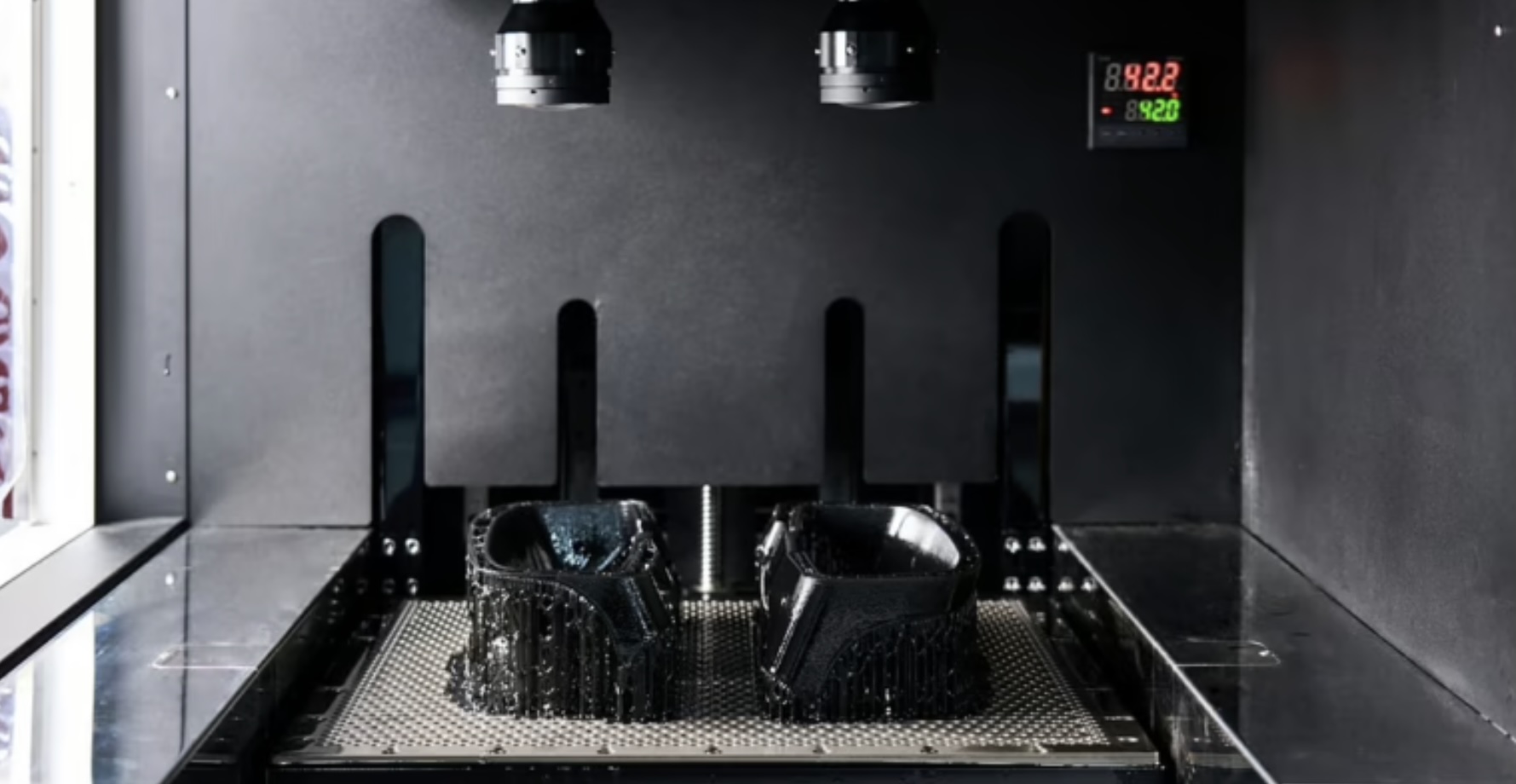
A DED-WAAM system fabricates a metal component by depositing material layer by layer. (Provided by Hyundai/Kia)

“The process is particularly effective for producing large structural components that would be difficult to manufacture as a single piece using conventional methods,” the release states.

“Beyond operating advanced equipment, the AMSC is advancing Design for Additive Manufacturing (DfAM) capabilities. Engineers optimize components specifically for additive production, enabling part consolidation, advanced lattice structures and lightweight geometries that improve efficiency while maintaining strength.”

Hyundai and Kia state that every fabricated component undergoes rigorous validation in the Quality Inspection Cell, where dimensional measurements, tensile strength, bending stiffness, and impact resistance are evaluated against production-equivalent standards.

“In-house material verification and metallurgical analysis further help ensure that additive-manufactured parts meet the same quality expectations as conventionally produced components,” the release states. “Additive manufacturing supports a growing range of applications across Hyundai Motor and Kia, from vehicle development and heritage restoration to motorsports and manufacturing operations.”

The release adds that for vehicle development, the technology enables rapid production of prototypes, development components, manufacturing jigs and fixtures, and service parts for discontinued vehicles or emergency replacement needs where conventional tooling would be impractical or time-consuming.

“As Hyundai Motor and Kia’s additive manufacturing hub, the AMSC will anchor the Group’s manufacturing competitiveness for years to come,” the release states. “The center’s integrated capabilities — spanning design, production, post-processing and validation — position it as a key hub for expanding additive manufacturing across Hyundai Motor Group.”

“We are rapidly internalizing additive manufacturing technologies through a growing range of applications across the group,” said Hanwoo On, senior manager of the additive manufacturing solutions team, in the release. Beyond vehicle components, we are expanding their use in high-value applications such as equipment consumables and manufacturing tools.”

The release adds that as modern cars shift toward software-defined vehicles (SDVs), “hardware is only half the battle.”

The release states that the final part of the series will provide an inside look at the NOVA Lab, where engineers test and validate a vehicle’s electrical architecture before a physical prototype hits the track.

Source : Hyundai

2026-08-07
Facebook Twitter linkedin Pinterest WhatsAppt Telegram Viber More

Authors

Posted by : Dr. Shibu John
Previous Article :

Alive3D Selects AEye’s Apollo for Next-Generation Sports Analytics

Next Article :

FARO CREAFORM Launches MetraSCAN BLACK2 to Enhance Flexibility for Shop-Floor Dimensional Inspection

Related Articles

FibreSeek Opens Pre-Sale of FibreSeeker 3 Continuous Carbon Fibre Printer

FibreSeek Opens Pre-Sale of FibreSeeker 3 Continuous Carbon Fibre Printer

Dr. Shibu John Thu Sep 2026
Divergent Builds America’s Most Advanced Industrial Metal 3D Printer, Monolith One, and Announces Second Factory

Divergent Builds America’s Most Advanced Industrial Metal 3D Printer, Monolith One, and Announces Second Factory

Dr. Shibu John Tue Sep 2026
Interview With Mr. Ravindra Kapse, Director & Co- Founder, Srujon Intelligent Solutions Pvt Ltd

Interview With Mr. Ravindra Kapse, Director & Co- Founder, Srujon Intelligent Solutions Pvt Ltd

Dr. Shibu John Mon Sep 2026
University of Waterloo 3D Prints Diamond-Shaped Electrodes for Flow Batteries

University of Waterloo 3D Prints Diamond-Shaped Electrodes for Flow Batteries

Dr. Shibu John Sat Sep 2026
University of Maine Launches 30-Foot 3D-Printed Offshore Boat

University of Maine Launches 30-Foot 3D-Printed Offshore Boat

Dr. Shibu John Sat Sep 2026

Leave a Reply Cancel reply

Your email address will not be published. Required fields are marked *

seco
first

Recent Posts

FibreSeek Opens Pre-Sale of FibreSeeker 3 Continuous Carbon Fibre Printer
3D Printing

FibreSeek Opens Pre-Sale of FibreSeeker 3 Continuous Carbon Fibre Printer

Dr. Shibu John Thu Sep 2026
Divergent Builds America’s Most Advanced Industrial Metal 3D Printer, Monolith One, and Announces Second Factory
3D Printing

Divergent Builds America’s Most Advanced Industrial Metal 3D Printer, Monolith One, and Announces Second Factory

Dr. Shibu John Tue Sep 2026
University of Waterloo 3D Prints Diamond-Shaped Electrodes for Flow Batteries
3D Printing

University of Waterloo 3D Prints Diamond-Shaped Electrodes for Flow Batteries

Dr. Shibu John Sat Sep 2026
University of Maine Launches 30-Foot 3D-Printed Offshore Boat
3D Printing

University of Maine Launches 30-Foot 3D-Printed Offshore Boat

Dr. Shibu John Sat Sep 2026
US Navy Pushes for 3D Printing to Strengthen Submarine Fleet and Industrial Base
3D Printing

US Navy Pushes for 3D Printing to Strengthen Submarine Fleet and Industrial Base

Dr. Shibu John Mon Aug 2026
FROM SPARE PARTS TO DIGITAL ASSETS FOR MARINE SECTOR
3D Digital Twin

FROM SPARE PARTS TO DIGITAL ASSETS FOR MARINE SECTOR

Dr. Shibu John Mon Aug 2026
Queen’s Belfast Team 3D Prints Dissolving Microneedle Patch for Skin Cancer
3D Printing

Queen’s Belfast Team 3D Prints Dissolving Microneedle Patch for Skin Cancer

Dr. Shibu John Sat Aug 2026
3D Printing, 3D Visualisation & AI-Enabled Digital Twins :  The Unseen Territory of Pharmaceutical Innovation
3D Design

3D Printing, 3D Visualisation & AI-Enabled Digital Twins : The Unseen Territory of Pharmaceutical Innovation

Dr. Shibu John Thu Aug 2026
WSU Team Prints NASA’s Copper Alloy at 500 Watts After AI Search
3D Printing

WSU Team Prints NASA’s Copper Alloy at 500 Watts After AI Search

Dr. Shibu John Thu Aug 2026
Engineers 3D Printed Permanent Zirconia Dental Crowns by Cutting a 100 Hours Process to 30 Minutes
3D Printing

Engineers 3D Printed Permanent Zirconia Dental Crowns by Cutting a 100 Hours Process to 30 Minutes

Dr. Shibu John Wed Aug 2026
3D-printing platform rapidly produces complex electric machines
3D Printing

3D-printing platform rapidly produces complex electric machines

Dr. Shibu John Tue Aug 2026

Advertisement

Advertisement


htmagazine
3D Graphy news is a information source for 3D Printing and 3d visualisation business

Follow us

Newsletter Subscription

Recent Posts

  • FibreSeek Opens Pre-Sale of FibreSeeker 3 Continuous Carbon Fibre Printer

    FibreSeek Opens Pre-Sale of FibreSeeker 3 Continuous Carbon Fibre Printer

    Dr. Shibu John Thu Sep 2026
  • Divergent Builds America’s Most Advanced Industrial Metal 3D Printer, Monolith One, and Announces Second Factory

    Divergent Builds America’s Most Advanced Industrial Metal 3D Printer, Monolith One, and Announces Second Factory

    Dr. Shibu John Tue Sep 2026
  • Interview With Mr. Ravindra Kapse, Director & Co- Founder, Srujon Intelligent Solutions Pvt Ltd

    Interview With Mr. Ravindra Kapse, Director & Co- Founder, Srujon Intelligent Solutions Pvt Ltd

    Dr. Shibu John Mon Sep 2026

Random Posts

FibreSeek Opens Pre-Sale of FibreSeeker 3 Continuous Carbon Fibre Printer

Divergent Builds America’s Most Advanced Industrial Metal 3D Printer, Monolith One, and Announces Second Factory

University of Waterloo 3D Prints Diamond-Shaped Electrodes for Flow Batteries

University of Maine Launches 30-Foot 3D-Printed Offshore Boat

US Navy Pushes for 3D Printing to Strengthen Submarine Fleet and Industrial Base

FROM SPARE PARTS TO DIGITAL ASSETS FOR MARINE SECTOR

Queen’s Belfast Team 3D Prints Dissolving Microneedle Patch for Skin Cancer

3D Printing, 3D Visualisation & AI-Enabled Digital Twins : The Unseen Territory of Pharmaceutical Innovation

WSU Team Prints NASA’s Copper Alloy at 500 Watts After AI Search

Engineers 3D Printed Permanent Zirconia Dental Crowns by Cutting a 100 Hours Process to 30 Minutes

Advertise with us Join Our WhatsApp Group
© Copyright 2024-30, All Rights Reserved
Powered by 3D GRAPHY LLP