

Advertise with us

3D GRAPHY NEWS

  • Home
  • Interviews
    • Text Interviews
    • video Interviews
  • R & D
  • Spotlight
    • Spotlight Text
    • Spotlight Videos
  • Medical
    • Medical Devices
    • Orthotics & Prosthetics
    • Pharma
    • Cardiology
    • Head & Neck
    • Neurology
    • Orthopaedics & Spine
    • Ayurveda
  • Dental
  • Engineering
    • Aerospace & Defence
    • Architecture & Construction
    • Marine & shipbuilding
    • Automotive
    • Energy
    • Heavy Industry
  • 3D Technologies
    • 3D Printing
    • 3D Scanning
    • 3D Software
    • 3D Simulation
    • 3D Design
    • 3D Visualisation
    • 3D Digital Twin
    • Artificial Intelligence
  • Materials
  • LifeStyle
    • Jewellery & Fashion
    • Gadgets
    • Pharma & Food
    • Art & Entertainment
  • About Us
    • About Us
    • Editors Desk
    • 3D Expert Desk
    • End users desk
    • Advertise with us
    • contact-us
  • News & Events
First ads
Second ads
Home» 3D Design»MIT’s 3D-Printed Concrete Bridge Shows Printer Hardware, Not Concrete, Is the Limiting Factor

MIT’s 3D-Printed Concrete Bridge Shows Printer Hardware, Not Concrete, Is the Limiting Factor

Dr. Shibu John Sat Aug 2026 3D Design, 3D Printing, Architecture, Construction Leave a comment 60 Views

Facebook Twitter linkedin Pinterest WhatsAppt Telegram Viber More

MIT researchers have 3D-printed and load-tested a 2.3-meter concrete bridge using a computational framework that bakes a printer’s physical limitations directly into the design process, and the results revealed a surprise: today’s printing hardware, not the strength of concrete, determines how efficient a structure can be.

The team, from MIT’s Department of Civil and Environmental Engineering, developed the framework to close a stubborn gap in the field. Engineers use topology optimization to find the strongest structure that uses the least material, but those mathematically ideal designs don’t account for what large-scale concrete printers can actually do — their thick nozzles, limited turning radius, and requirement to print in a single continuous motion. The new approach folds all three constraints directly into the math, generating fully printable designs in about two minutes on a laptop. When the team needed to slightly reduce the bridge’s size on the day of printing, they reran the optimization and had an updated design five to 10 minutes later.
MIT's 3D-Printed Concrete Bridge Shows Printer Hardware, Not Concrete, Is the Limiting Factor
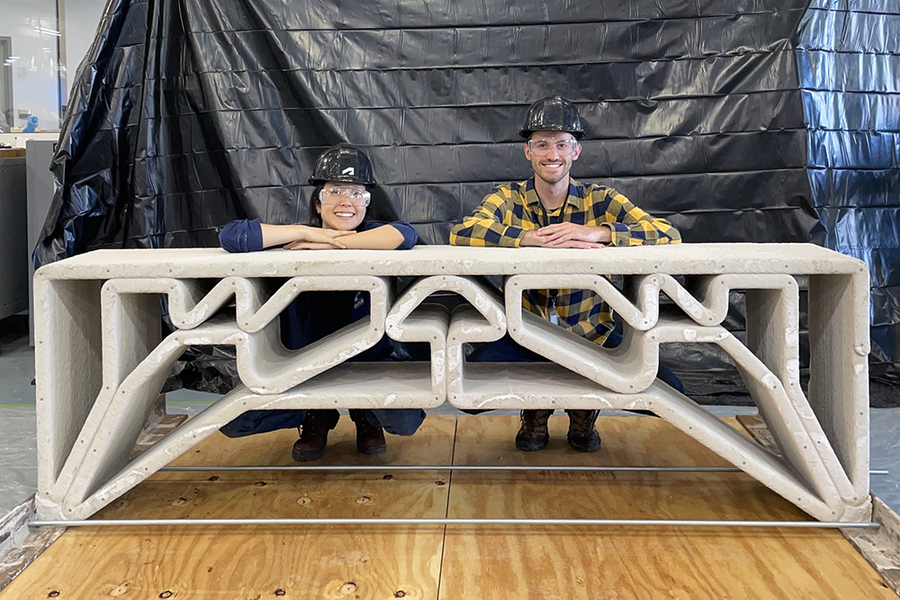
MIT Department of Civil and Environmental Engineering postdoc Hajin Kim-Tackowiak (left) and graduate student Zane Schemmer pose with the 3D-printed concrete bridge they designed and load-tested. (Credit: Photo courtesy of the researchers.)


The bridge itself took about 30 minutes to print using off-the-shelf mortar. During testing, the roughly 900-pound structure held more than 2,000 pounds of concrete blocks spread across its top without measurably bending, closely matching the team’s simulations. But the test exposed how over-engineered the result was. “From zero to 200,000 pounds, your design is entirely driven by these ‘can I build it or not’ constraints. And then, after 200,000 pounds, you can start to think about the physics,” said co-first author Hajin Kim-Tackowiak, a postdoc in MIT’s CEE department.

The framework uses mixed-integer optimization, a mathematical approach long considered too computationally expensive to be practical. “You go back five, 10 years ago, the solver we used, even three years ago, could not solve these problems,” said co-first author Zane Schemmer, a PhD student in CEE. Because the method finds a global optimum rather than just a good solution, the researchers could also quantify precisely what each hardware constraint costs in material. The single biggest factor was bead width. The bridge used a 4-centimeter bead; a machine capable of laying a 1-centimeter bead could cut material use by as much as 76 percent, according to senior author Josephine Carstensen, the Gilbert W. Winslow (1937) Career Development Professor in Civil Engineering. “I thought the continuous path would be the problem, the one that had the highest effect,” Carstensen said. “But it wasn’t. It was the bead width.”

The bridge is built entirely in compression, which is concrete’s strength. Every element is being pushed rather than pulled. That design principle revealed itself dramatically after testing: the structure had held more than 2,000 pounds without budging, but when a worker lifted one corner a few inches to sweep beneath it, it broke immediately. “It’s optimal in one way, but it’s definitely not optimal in every way,” Kim-Tackowiak said.

The team’s next step is reinforced concrete. “We know a pure concrete structure is not necessarily going to be the most optimal thing, so we’re moving it more into the world we live in today, which is reinforced concrete,” Kim-Tackowiak said, though she added that working out how to feed rebar into a printed concrete structure “is proving its own challenge.” The work was funded by the National Science Foundation and supported by the MIT Center for Advanced Production Technologies, with co-authors Pittipat Wongsittikan, a PhD student in MIT’s Building Technology Architecture program, and Jackson Jewett MEng ’18, PhD ’25.

Source: news.mit.edu

2026-08-01
Facebook Twitter linkedin Pinterest WhatsAppt Telegram Viber More

Authors

Posted by : Dr. Shibu John
Previous Article :

Siemens launches Teamcenter Digital Reality Viewer and Digital Twin Composer in India

Next Article :

Justin Bieber Launches 3D Printed Sneakers Through Skylrk Brand Partnership with Zellerfeld

Related Articles

iAM3D Unveils LPW Z2500, a Large-Format Multi-Axis Laser DED Platform for High-Performance Metal Manufacturing

iAM3D Unveils LPW Z2500, a Large-Format Multi-Axis Laser DED Platform for High-Performance Metal Manufacturing

Dr. Shibu John Thu Aug 2026
Stratasys and Limbitless Solutions Expand Ongoing Partnership Providing Access to 3D-Printed Prosthetics for Children

Stratasys and Limbitless Solutions Expand Ongoing Partnership Providing Access to 3D-Printed Prosthetics for Children

Dr. Shibu John Wed Aug 2026
Heidelberg Team Designs Recyclable Polymer for Light-Based 3D Printing

Heidelberg Team Designs Recyclable Polymer for Light-Based 3D Printing

Dr. Shibu John Wed Aug 2026
European Researchers 3D Print Glass-like Metallic Components for More Efficient Electric Motors

European Researchers 3D Print Glass-like Metallic Components for More Efficient Electric Motors

Dr. Shibu John Wed Aug 2026
3D Systems Receives $9 Million Contract Award from U.S. Air Force for Advanced Large-Format Metal 3D Printing System

3D Systems Receives $9 Million Contract Award from U.S. Air Force for Advanced Large-Format Metal 3D Printing System

Dr. Shibu John Wed Aug 2026

Leave a Reply Cancel reply

Your email address will not be published. Required fields are marked *

seco
first

Recent Posts

iAM3D Unveils LPW Z2500, a Large-Format Multi-Axis Laser DED Platform for High-Performance Metal Manufacturing
3D Printing

iAM3D Unveils LPW Z2500, a Large-Format Multi-Axis Laser DED Platform for High-Performance Metal Manufacturing

Dr. Shibu John Thu Aug 2026
Stratasys and Limbitless Solutions Expand Ongoing Partnership Providing Access to 3D-Printed Prosthetics for Children
3D Printing

Stratasys and Limbitless Solutions Expand Ongoing Partnership Providing Access to 3D-Printed Prosthetics for Children

Dr. Shibu John Wed Aug 2026
Heidelberg Team Designs Recyclable Polymer for Light-Based 3D Printing
3D Printing

Heidelberg Team Designs Recyclable Polymer for Light-Based 3D Printing

Dr. Shibu John Wed Aug 2026
European Researchers 3D Print Glass-like Metallic Components for More Efficient Electric Motors
3D Printing

European Researchers 3D Print Glass-like Metallic Components for More Efficient Electric Motors

Dr. Shibu John Wed Aug 2026
3D Systems Receives $9 Million Contract Award from U.S. Air Force for Advanced Large-Format Metal 3D Printing System
3D Printing

3D Systems Receives $9 Million Contract Award from U.S. Air Force for Advanced Large-Format Metal 3D Printing System

Dr. Shibu John Wed Aug 2026
MIT turns pine-cone mechanics into 3D-printable adaptive materials
3D Printing

MIT turns pine-cone mechanics into 3D-printable adaptive materials

Dr. Shibu John Wed Aug 2026
Tel Aviv Team Creates Bioactive Ink for Precise 3D Printing
3D Printing

Tel Aviv Team Creates Bioactive Ink for Precise 3D Printing

Dr. Shibu John Wed Aug 2026
EPFL 3D-prints tiny drones that fly on sound alone
3D Printing

EPFL 3D-prints tiny drones that fly on sound alone

Dr. Shibu John Sun Aug 2026
Notre Dame researchers 3D print blood capillaries smaller than a human hair
3D Printing

Notre Dame researchers 3D print blood capillaries smaller than a human hair

Dr. Shibu John Sun Aug 2026
3D Printed Coral-Inspired Scaffold Reprograms Immune Cells to Heal Bone Disease
3D Printing

3D Printed Coral-Inspired Scaffold Reprograms Immune Cells to Heal Bone Disease

Dr. Shibu John Sun Aug 2026
India’s New Drug Development Paradigm: 3D Tissue Models, AI and Digital Twins
3D Printing

India’s New Drug Development Paradigm: 3D Tissue Models, AI and Digital Twins

Dr. Shibu John Fri Aug 2026

Advertisement

Advertisement


htmagazine
3D Graphy news is a information source for 3D Printing and 3d visualisation business

Follow us

Newsletter Subscription

Recent Posts

  • Autodesk for Small Business update: Making it more affordable to get started with Autodesk Flex

    Autodesk for Small Business update: Making it more affordable to get started with Autodesk Flex

    Dr. Shibu John Fri Aug 2026
  • LLNL Team Prints Ceramic Waveguide Lasers By Direct Ink Writing

    LLNL Team Prints Ceramic Waveguide Lasers By Direct Ink Writing

    Dr. Shibu John Fri Aug 2026
  • NSAM 2.0: India’s Next Leap in Additive Manufacturing

    NSAM 2.0: India’s Next Leap in Additive Manufacturing

    Dr. Shibu John Thu Aug 2026

Random Posts

iAM3D Unveils LPW Z2500, a Large-Format Multi-Axis Laser DED Platform for High-Performance Metal Manufacturing

Stratasys and Limbitless Solutions Expand Ongoing Partnership Providing Access to 3D-Printed Prosthetics for Children

Heidelberg Team Designs Recyclable Polymer for Light-Based 3D Printing

European Researchers 3D Print Glass-like Metallic Components for More Efficient Electric Motors

3D Systems Receives $9 Million Contract Award from U.S. Air Force for Advanced Large-Format Metal 3D Printing System

MIT turns pine-cone mechanics into 3D-printable adaptive materials

Tel Aviv Team Creates Bioactive Ink for Precise 3D Printing

EPFL 3D-prints tiny drones that fly on sound alone

Notre Dame researchers 3D print blood capillaries smaller than a human hair

3D Printed Coral-Inspired Scaffold Reprograms Immune Cells to Heal Bone Disease

Advertise with us Join Our WhatsApp Group
© Copyright 2024-30, All Rights Reserved
Powered by 3D GRAPHY LLP