

Advertise with us

3D GRAPHY NEWS

  • Home
  • Interviews
    • Text Interviews
    • video Interviews
  • R & D
  • Spotlight
    • Spotlight Text
    • Spotlight Videos
  • Medical
    • Medical Devices
    • Orthotics & Prosthetics
    • Pharma
    • Cardiology
    • Head & Neck
    • Neurology
    • Orthopaedics & Spine
    • Ayurveda
  • Dental
  • Engineering
    • Aerospace & Defence
    • Architecture & Construction
    • Marine & shipbuilding
    • Automotive
    • Energy
    • Heavy Industry
  • 3D Technologies
    • 3D Printing
    • 3D Scanning
    • 3D Software
    • 3D Simulation
    • 3D Design
    • 3D Visualisation
    • 3D Digital Twin
    • Artificial Intelligence
  • Materials
  • LifeStyle
    • Jewellery & Fashion
    • Gadgets
    • Pharma & Food
    • Art & Entertainment
  • About Us
    • About Us
    • Editors Desk
    • 3D Expert Desk
    • End users desk
    • Advertise with us
    • contact-us
  • News & Events
First ads
Second ads
Home» 3D Design»Western University Uses AI and 3D Printing to Keep Pace With Children’s Growing Ears

Western University Uses AI and 3D Printing to Keep Pace With Children’s Growing Ears

Dr. Shibu John Thu Jul 2026 3D Design, Medical, Medical Devices, News, Spotlight Text Leave a comment 134 Views

Facebook Twitter linkedin Pinterest WhatsAppt Telegram Viber More

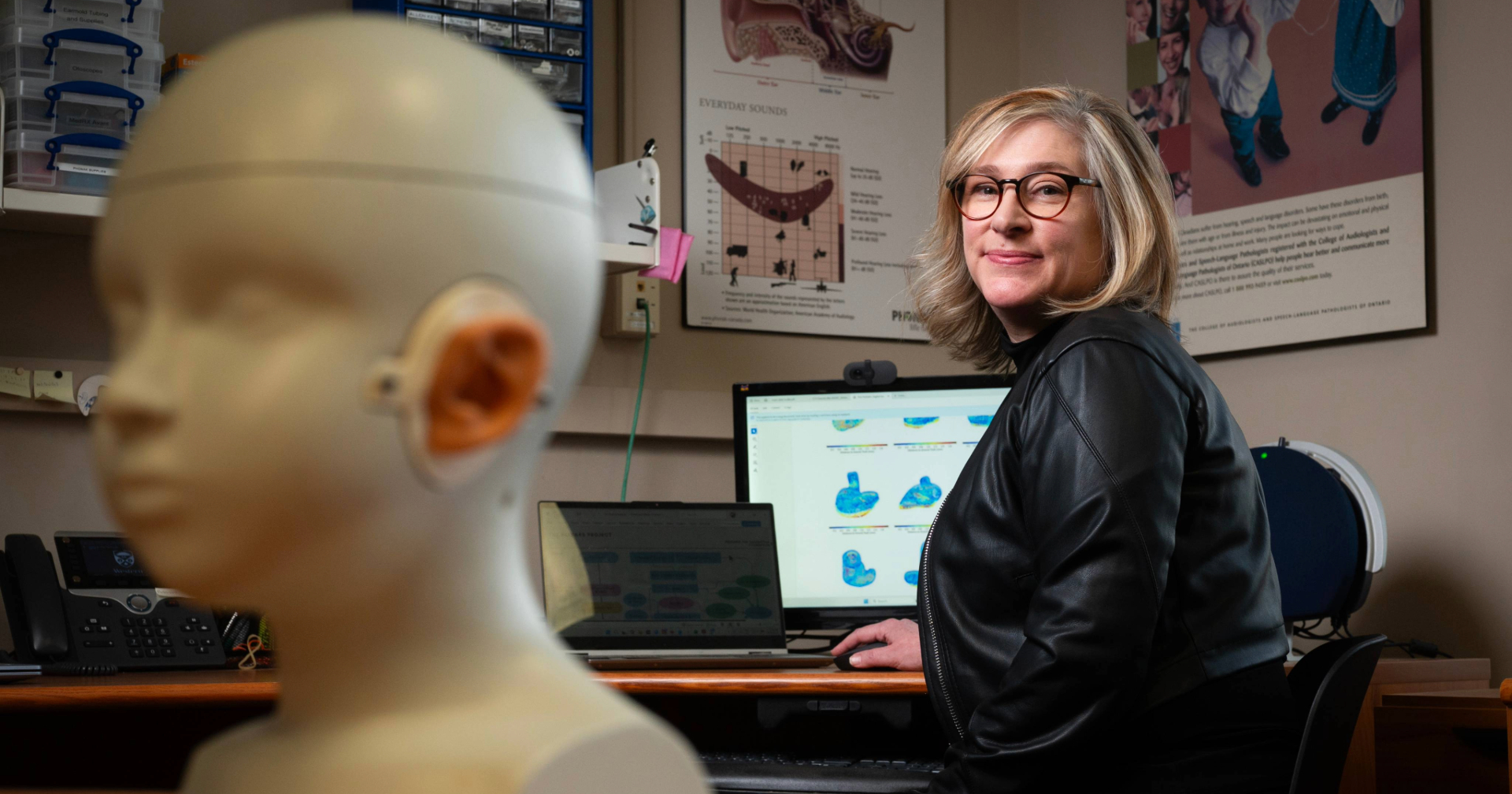
Susan Scollie, audiologist, professor in the Faculty of Health Sciences and lead investigator on the ALLEars Project.
Credit: Iulia Costache/Western Health Sciences

Researchers at Western University have launched a four-year, $4.4-million (USD) project that uses artificial intelligence and 3D printing to produce custom hearing-aid earmolds for children before they’ve outgrown the ones they’re wearing. The ALLEars project, funded by the Oberkotter Foundation and developed in partnership with Boys Town National Research Hospital in Nebraska, aims to replace a slow, reactive process that currently leaves some children waiting up to 21 days for replacement earmolds.

The core problem is straightforward: children’s ears grow fast, and earmolds that fit perfectly one month won’t fit the next. The World Health Organization estimates 34 million children worldwide are deaf or hard of hearing, and hearing aids can’t function correctly without a custom-fitted earmold. Right now, families cycle through audiology appointments to get new impressions taken, then wait weeks for the physical molds to arrive. “In the first few years of life, children are going through a really rapid period of growth,” said Susan Scollie, professor in Western’s Faculty of Health Sciences, audiologist, and lead investigator on ALLEars. “That growth can repeatedly interrupt their hearing aid use during the critical language development years.”

ALLEars will build a training dataset from thousands of ear impressions collected from children, then use that data to train an AI model that predicts how a child’s ear will change over time. Once a prediction is made, the digital file goes to the lab of Joshua Pearce, a professor in Western’s Faculty of Engineering, where postdoctoral research associate Alessia Romani translates it into a 3D-printed physical earmold. “We’re bringing a completely fresh and new high-tech approach to an old problem: kids outgrowing their earmolds faster than we can make them,” Scollie said.

Soodeh Nikan, an engineering professor and the project’s AI lead, is also developing a mirroring technique where the AI uses the scan of one ear to predict the shape of the other. That could cut the number of impressions young children need to endure. “If a child receives an impression on the left ear, they don’t need to repeat it for the right ear,” Nikan said. Separately, Boys Town’s team, led by vice president of research Ryan McCreery, is applying machine learning to predict how sound changes inside a child’s ear canal as they grow, ensuring hearing aids deliver the correct amplification levels over time.

The team is designing the entire workflow to be openly shared with hearing healthcare providers worldwide. Pearce’s lab is focused on making the production process fast and low-cost, with particular attention to low- and middle-income countries where access to earmold manufacturers is limited or nonexistent.

One of the pilot study’s participants is an eight-year-old boy who has worn hearing aids since he was six months old. His mother, Emily, described the real-world weight of the current system. “It can take 14 to 21 days to get earmolds back after an ear impression. Two weeks is a long time for him to have to wait to get his hearing back to where it needs to be.” She contributed her son’s former earmolds to help researchers map how ears change over time, saying, “If the ALLEars project reduces those barriers — minimizing wait times and making it easier to get earmolds — it’s going to impact families.”

“If we can reduce appointments, expand global access to earmold manufacturing and solve a daily clinical challenge for audiologists, it will be game-changing. This project is a once-in-a-lifetime opportunity,” Scollie said. Families with pediatric earmolds to contribute to the project can contact the research team at allears@uwo.ca.

Source: news westernu ca

2026-07-30
Facebook Twitter linkedin Pinterest WhatsAppt Telegram Viber More

Authors

Posted by : Dr. Shibu John
Previous Article :

SHINING 3D Launches EinScan Rigil Lite: A More Accessible All-in-One 3D Scanner for Professional Users

Next Article :

Adidas Debuts 3D Printed Basketball Shoe

Related Articles

NTU Researchers 3D Print a Bone Scaffold Timed to How Injuries Heal

NTU Researchers 3D Print a Bone Scaffold Timed to How Injuries Heal

Dr. Shibu John Thu Oct 2026
FROM SPARE PARTS TO DIGITAL ASSETS FOR MARINE SECTOR

FROM SPARE PARTS TO DIGITAL ASSETS FOR MARINE SECTOR

Dr. Shibu John Mon Aug 2026
Queen’s Belfast Team 3D Prints Dissolving Microneedle Patch for Skin Cancer

Queen’s Belfast Team 3D Prints Dissolving Microneedle Patch for Skin Cancer

Dr. Shibu John Sat Aug 2026
3D Printing, 3D Visualisation & AI-Enabled Digital Twins :  The Unseen Territory of Pharmaceutical Innovation

3D Printing, 3D Visualisation & AI-Enabled Digital Twins : The Unseen Territory of Pharmaceutical Innovation

Dr. Shibu John Thu Aug 2026
USC Team Prints Stretchable MRI Coils in Under 10 Minutes

USC Team Prints Stretchable MRI Coils in Under 10 Minutes

Dr. Shibu John Wed Aug 2026

Leave a Reply Cancel reply

Your email address will not be published. Required fields are marked *

seco
first

Recent Posts

Formlabs Launches Form Studio 1 Resin Printer From $699
3D Printing

Formlabs Launches Form Studio 1 Resin Printer From $699

Dr. Shibu John Fri Oct 2026
TU Delft 3D-Prints a Short Joint Between Stiff and Flexible Lattices
3D Printing

TU Delft 3D-Prints a Short Joint Between Stiff and Flexible Lattices

Dr. Shibu John Thu Oct 2026
Harbin Researchers 3D-Print Cement That Stores Electricity
3D Printing

Harbin Researchers 3D-Print Cement That Stores Electricity

Dr. Shibu John Thu Oct 2026
NTU Researchers 3D Print a Bone Scaffold Timed to How Injuries Heal
3D Printing

NTU Researchers 3D Print a Bone Scaffold Timed to How Injuries Heal

Dr. Shibu John Thu Oct 2026
FibreSeek Opens Pre-Sale of FibreSeeker 3 Continuous Carbon Fibre Printer
3D Printing

FibreSeek Opens Pre-Sale of FibreSeeker 3 Continuous Carbon Fibre Printer

Dr. Shibu John Thu Sep 2026
Divergent Builds America’s Most Advanced Industrial Metal 3D Printer, Monolith One, and Announces Second Factory
3D Printing

Divergent Builds America’s Most Advanced Industrial Metal 3D Printer, Monolith One, and Announces Second Factory

Dr. Shibu John Tue Sep 2026
University of Waterloo 3D Prints Diamond-Shaped Electrodes for Flow Batteries
3D Printing

University of Waterloo 3D Prints Diamond-Shaped Electrodes for Flow Batteries

Dr. Shibu John Sat Sep 2026
University of Maine Launches 30-Foot 3D-Printed Offshore Boat
3D Printing

University of Maine Launches 30-Foot 3D-Printed Offshore Boat

Dr. Shibu John Sat Sep 2026
US Navy Pushes for 3D Printing to Strengthen Submarine Fleet and Industrial Base
3D Printing

US Navy Pushes for 3D Printing to Strengthen Submarine Fleet and Industrial Base

Dr. Shibu John Mon Aug 2026
FROM SPARE PARTS TO DIGITAL ASSETS FOR MARINE SECTOR
3D Digital Twin

FROM SPARE PARTS TO DIGITAL ASSETS FOR MARINE SECTOR

Dr. Shibu John Mon Aug 2026
Queen’s Belfast Team 3D Prints Dissolving Microneedle Patch for Skin Cancer
3D Printing

Queen’s Belfast Team 3D Prints Dissolving Microneedle Patch for Skin Cancer

Dr. Shibu John Sat Aug 2026

Advertisement

Advertisement


htmagazine
3D Graphy news is a information source for 3D Printing and 3d visualisation business

Follow us

Newsletter Subscription

Recent Posts

  • Formlabs Launches Form Studio 1 Resin Printer From $699

    Formlabs Launches Form Studio 1 Resin Printer From $699

    Dr. Shibu John Fri Oct 2026
  • Purposeful porosity: A peek into PermiAM technology

    Purposeful porosity: A peek into PermiAM technology

    Dr. Shibu John Sat Oct 2026
  • SHINING 3D Launches ShiningSpace, a Browser Platform for Real-World 3D Scans

    SHINING 3D Launches ShiningSpace, a Browser Platform for Real-World 3D Scans

    Dr. Shibu John Thu Oct 2026

Random Posts

Formlabs Launches Form Studio 1 Resin Printer From $699

TU Delft 3D-Prints a Short Joint Between Stiff and Flexible Lattices

Harbin Researchers 3D-Print Cement That Stores Electricity

NTU Researchers 3D Print a Bone Scaffold Timed to How Injuries Heal

FibreSeek Opens Pre-Sale of FibreSeeker 3 Continuous Carbon Fibre Printer

Divergent Builds America’s Most Advanced Industrial Metal 3D Printer, Monolith One, and Announces Second Factory

University of Waterloo 3D Prints Diamond-Shaped Electrodes for Flow Batteries

University of Maine Launches 30-Foot 3D-Printed Offshore Boat

US Navy Pushes for 3D Printing to Strengthen Submarine Fleet and Industrial Base

FROM SPARE PARTS TO DIGITAL ASSETS FOR MARINE SECTOR

Advertise with us Join Our WhatsApp Group
© Copyright 2024-30, All Rights Reserved
Powered by 3D GRAPHY LLP