

3D GRAPHY NEWS

  • Home
  • Interviews
    • Text Interviews
    • video Interviews
  • R & D
  • Spotlight
    • Spotlight Text
    • Spotlight Videos
  • Medical
  • Dental
  • Engineering
  • 3D Technologies
    • 3D Printing
    • 3D Scanning
    • 3D Software
    • 3D Simulation
    • 3D Design
    • 3D Visualisation
    • Materials
    • Digital Twin
  • News & Events
  • About Us
    • About Us
    • Editors Desk
    • 3D Expert Desk
    • End users desk
    • Advertise with us
    • contact-us
Home» 3D Printing»U.S. Naval Research Laboratory Develops 3D Printed Antennas and Arrays to Advance Radar Technology

U.S. Naval Research Laboratory Develops 3D Printed Antennas and Arrays to Advance Radar Technology

Dr. Shibu John Tue Jul 2024 3D Printing, Defence, News & Events, R & D, Spotlight Text Leave a comment 490 Views

Facebook Twitter linkedin Pinterest WhatsAppt Telegram Viber More

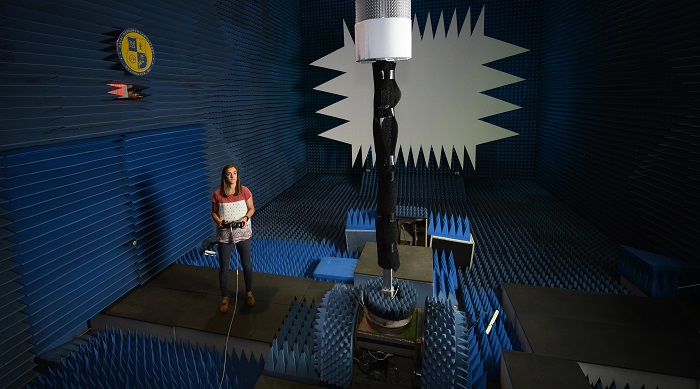
Experts at the U.S. Naval Research Laboratory have created and tested 3D-printed antennas and arrays to advance radar technology and enable new applications for the U.S. Navy. The lightweight and rapid production of 3D-printed parts make it an attractive alternative to traditional manufacturing that often requires expensive materials and specialized equipment. 3D printing is a way to produce rapid prototypes and get through multiple design iterations very quickly, with minimal cost.

Radar systems perform critical functions for the Navy and remain an important part of maritime navigation and national defense. Parts for antennas and arrays, which are multiple connected antennas working together as one, may unexpectedly break or wear out requiring replacement. Traditionally, parts are ordered or intricately machined out of metal, sometimes taking weeks to produce. 3D-printed radar parts, such as a cylindrical array, which provide 360-degree visibility, can be produced within hours versus several days using traditional methods due to the reduced machining and assembly time.

In addition to the production benefits, the relatively low cost of 3D printing materials enable researchers to test multiple versions of parts at minimal overhead. The perfected prototypes can then be machined using traditional methods. Once a prototype is successfully produced, whether 3D printed or traditionally manufactured, it must undergo rigorous testing before it is used operationally. In early 2019, Anna Stumme submitted a paper comparing 3D-printed parts against traditionally manufactured parts at the Antenna Applications Symposium. She won the student paper contest for her research.

New Applications

Stumme and her colleagues are investigating how weight-and-size-constrained applications, such as unmanned aerial vehicles or small ships, can benefit from 3D-printed parts. Many of the 3D prototypes are printed using lightweight nylon in NRL’s Laboratory for Autonomous Systems Research facility. Once the part is printed, it undergoes a process called electroplating.

During the electroplating process, a thin coat of metal is applied to the printed part. Electroplating provides a conductive surface for the device to radiate as intended; something that isn’t feasible with plastic alone. The result is a lightweight prototype that can then be evaluated for a variety of attributes, such as surface roughness – a major factor in the functionality of antenna elements.

Stumme collaborates with NRL materials scientists from across NRL, who perform critical surface roughness characterization. Surface roughness characterization provides an assessment of the coating on an antenna, and the impact toughness has on its performance.

Surface roughness is important for waveguides and antennas because it can cause scattering losses and result in a less efficient antenna. Antennas radiate and receive waves. So if a wave runs along a rough surface it is distorted and the energy may not go where it wanted to go.

Nick Charipar and his team, part of NRL’s Material Science & Technology Division, prototype 3D printed parts for the NRL’s Radar Division. Once the part is created, researchers investigate how the material features impact the functionality of the radar. Each 3D printer has unique characteristics that may alter product performance. If researchers can figure out the optimal parameters for specific 3D printed parts, Stumme and her colleagues agree ships could become self-reliant for those critical parts anywhere in the world.

Next Steps

Despite current COVID-19 restrictions, research at NRL continues to thrive from a distance. Later this year, Stumme and her colleagues plan to demonstrate new prototype cylindrical array apertures for an X-band surveillance radar demonstration in a laboratory setting. The X-band surveillance radar is designed to search the area surrounding a particular platform, such as a ship. They are exploring integrating cylindrical arrays into the masts of smaller vessels using microwave photonics and optical fibers.

Cylindrical arrays are advantageous because they provide full 360-degree visibility. Optical fibers are valuable because they can allow for long separations between the antenna itself and where the processing is conducted.

Using optical fibers reduces the number of components required on a Navy ship’s mast, further reducing heat and weight constraints. The demonstration will include testing traditionally manufactured and 3D printed versions of the array to compare performance. Stumme designed both versions.

2024-07-16
Facebook Twitter linkedin Pinterest WhatsAppt Telegram Viber More

Authors

Posted by : Dr. Shibu John
Previous Article :

Researchers Develop Shape-Changing 3D Printing Nozzle for Fiber-Filled Composites Based 3D Printing

Next Article :

Mantle Secures $20M to Expand Metal 3D Printing

Related Articles

Marines 3D-Print Coast Guard Replacement Part in Hours During South Korea Exercise

Marines 3D-Print Coast Guard Replacement Part in Hours During South Korea Exercise

Dr. Shibu John Mon Jul 2026
BASF Starts Up World’s First Industrial-Scale 3D Printed Catalyst Plant in Ludwigshafen

BASF Starts Up World’s First Industrial-Scale 3D Printed Catalyst Plant in Ludwigshafen

Dr. Shibu John Sun Jul 2026
BENTU Design 3D Prints Street Furniture From Demolished Urban Village Waste

BENTU Design 3D Prints Street Furniture From Demolished Urban Village Waste

Dr. Shibu John Sun Jul 2026
Beehive Industries Wins $30 Million Air Force Contract for 3D-Printed Turbojets

Beehive Industries Wins $30 Million Air Force Contract for 3D-Printed Turbojets

Dr. Shibu John Sun Jul 2026
Holcim & COBOD Complete Europe’s Largest Residential Build in 12 Months

Holcim & COBOD Complete Europe’s Largest Residential Build in 12 Months

Dr. Shibu John Sun Jul 2026

Leave a Reply Cancel reply

Your email address will not be published. Required fields are marked *

Recent Posts

Marines 3D-Print Coast Guard Replacement Part in Hours During South Korea Exercise
3D Design

Marines 3D-Print Coast Guard Replacement Part in Hours During South Korea Exercise

Dr. Shibu John Mon Jul 2026
BASF Starts Up World’s First Industrial-Scale 3D Printed Catalyst Plant in Ludwigshafen
3D Printing

BASF Starts Up World’s First Industrial-Scale 3D Printed Catalyst Plant in Ludwigshafen

Dr. Shibu John Sun Jul 2026
BENTU Design 3D Prints Street Furniture From Demolished Urban Village Waste
3D Design

BENTU Design 3D Prints Street Furniture From Demolished Urban Village Waste

Dr. Shibu John Sun Jul 2026
Beehive Industries Wins $30 Million Air Force Contract for 3D-Printed Turbojets
3D Printing

Beehive Industries Wins $30 Million Air Force Contract for 3D-Printed Turbojets

Dr. Shibu John Sun Jul 2026
Holcim & COBOD Complete Europe’s Largest Residential Build in 12 Months
3D Printing

Holcim & COBOD Complete Europe’s Largest Residential Build in 12 Months

Dr. Shibu John Sun Jul 2026
Ottobock Launches 3D Printed Silicone Liner to Address Prosthesis Fit Problems Affecting 68% of Users
3D Printing

Ottobock Launches 3D Printed Silicone Liner to Address Prosthesis Fit Problems Affecting 68% of Users

Dr. Shibu John Sun Jul 2026
Rotterdam Studio Covers Dutch Transformer Station in 322 Custom 3D Printed Ceramic Tiles
3D Printing

Rotterdam Studio Covers Dutch Transformer Station in 322 Custom 3D Printed Ceramic Tiles

Dr. Shibu John Sun Jul 2026
Inside Vietnam’s First Connected Surgical Ecosystem, and the Role 3D Printing Plays Within It
3D Printing

Inside Vietnam’s First Connected Surgical Ecosystem, and the Role 3D Printing Plays Within It

Dr. Shibu John Sun Jul 2026
Czech Scientists Test 3D-Printed Titanium Implants That Release Drugs Inside the Body
3D Printing

Czech Scientists Test 3D-Printed Titanium Implants That Release Drugs Inside the Body

Dr. Shibu John Sun Jul 2026
Ford and Sharrow Engineering Cut Marine Propeller Production Time from 130 Days to Two Weeks
3D Design

Ford and Sharrow Engineering Cut Marine Propeller Production Time from 130 Days to Two Weeks

Dr. Shibu John Fri Jul 2026
Superfeet Launches iPhone Scanning for Custom 3D-Printed Insoles
3D Printing

Superfeet Launches iPhone Scanning for Custom 3D-Printed Insoles

Dr. Shibu John Fri Jul 2026

htmagazine
3D Graphy news is a information source for 3D Printing and 3d visualisation business

Follow us

Newsletter Subscription

Recent Posts

  • Marines 3D-Print Coast Guard Replacement Part in Hours During South Korea Exercise

    Marines 3D-Print Coast Guard Replacement Part in Hours During South Korea Exercise

    Dr. Shibu John Mon Jul 2026
  • Sandvik acquires CAM re-sellers in India and US

    Sandvik acquires CAM re-sellers in India and US

    Dr. Shibu John Sun Jul 2026
  • BASF Starts Up World’s First Industrial-Scale 3D Printed Catalyst Plant in Ludwigshafen

    BASF Starts Up World’s First Industrial-Scale 3D Printed Catalyst Plant in Ludwigshafen

    Dr. Shibu John Sun Jul 2026

Random Posts

Marines 3D-Print Coast Guard Replacement Part in Hours During South Korea Exercise

Marines 3D-Print Coast Guard Replacement Part in Hours During South Korea Exercise

BASF Starts Up World’s First Industrial-Scale 3D Printed Catalyst Plant in Ludwigshafen

BASF Starts Up World’s First Industrial-Scale 3D Printed Catalyst Plant in Ludwigshafen

BENTU Design 3D Prints Street Furniture From Demolished Urban Village Waste

BENTU Design 3D Prints Street Furniture From Demolished Urban Village Waste

Beehive Industries Wins $30 Million Air Force Contract for 3D-Printed Turbojets

Beehive Industries Wins $30 Million Air Force Contract for 3D-Printed Turbojets

Holcim & COBOD Complete Europe’s Largest Residential Build in 12 Months

Holcim & COBOD Complete Europe’s Largest Residential Build in 12 Months

Ottobock Launches 3D Printed Silicone Liner to Address Prosthesis Fit Problems Affecting 68% of Users

Ottobock Launches 3D Printed Silicone Liner to Address Prosthesis Fit Problems Affecting 68% of Users

Rotterdam Studio Covers Dutch Transformer Station in 322 Custom 3D Printed Ceramic Tiles

Rotterdam Studio Covers Dutch Transformer Station in 322 Custom 3D Printed Ceramic Tiles

Inside Vietnam’s First Connected Surgical Ecosystem, and the Role 3D Printing Plays Within It

Inside Vietnam’s First Connected Surgical Ecosystem, and the Role 3D Printing Plays Within It

Czech Scientists Test 3D-Printed Titanium Implants That Release Drugs Inside the Body

Czech Scientists Test 3D-Printed Titanium Implants That Release Drugs Inside the Body

Ford and Sharrow Engineering Cut Marine Propeller Production Time from 130 Days to Two Weeks

Ford and Sharrow Engineering Cut Marine Propeller Production Time from 130 Days to Two Weeks

Tags

3D Design 3D Software Business Dental Engineering Medical News & Events Technology Trending Video Interviews
© Copyright 2024-30, All Rights Reserved
Powered by 3D GRAPHY LLP