

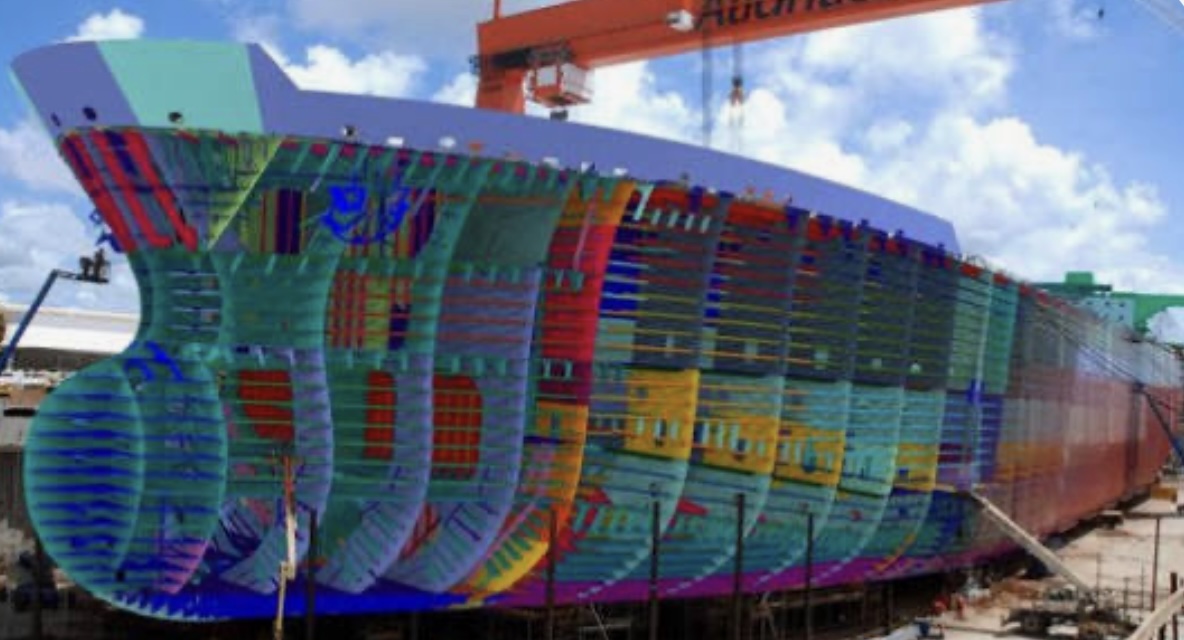
How 3D Printing, 3D Scanning, Simulation, Visualisation, DED and AI-Enabled Digital Twins Could Redefine Marine Engineering, Shipbuilding and Submarine Sustainment
A Special 3D GRAPHY NEWS – MARINE & DEFENCE FEATURE

By Cmde. Niranjan Khardenavis (Retd.)
Director – Marine & Defence, 3D GRAPHY LLP
Special Correspondent – Marine & Defence, 3D GRAPHY NEWS
“The future of maritime engineering will not be defined by one technology. It will be defined by the integration of 3D technologies, advanced materials, AI and Digital Twins into one continuous digital manufacturing and maintenance ecosystem.”
— Cmde. Niranjan Khardenavis (Retd.)
Director – Marine & Defence, 3D GRAPHY LLP
EDITORIAL MESSAGE
The Maritime Industry Must Move From Physical Inventories to Digital Intelligence
Dr. Shibu John
Managing Editor & Founder, 3D GRAPHY NEWS
Founder & CEO, 3D GRAPHY LLP
The maritime industry is entering a defining technological phase.
For decades, the reliability of ships, submarines, offshore platforms and marine engineering systems has depended upon physical inventories, engineering drawings, conventional manufacturing, geographically distributed suppliers and large maintenance ecosystems.
That model served the industry well.
But the requirements of modern maritime operations are changing.
Ships are becoming more sophisticated. Supply chains are becoming more complex. Platforms are expected to remain operational for longer periods. Specialised components are often required in very small quantities. Older vessels can contain components for which original manufacturers, drawings or tooling may no longer exist.
This is where I believe 3D Technology and AI-enabled Digital Twins can create a fundamental transformation.
The combination of 3D Printing, 3D Scanning, Reverse Engineering, 3D Simulation, 3D Visualisation, 3D Metrology, advanced 3D printable materials, Direct Energy Deposition and Artificial Intelligence can create a new digital manufacturing architecture for the maritime sector.
The idea is simple but powerful:
Scan the part. Digitise it. Simulate it. Validate it. Store it digitally. Manufacture it when required. Inspect it. Use it. Monitor it. Repair it. And ultimately create a Digital Twin of the entire asset.
This is much bigger than 3D Printing.
It is the emergence of Digital Maritime Manufacturing.
India has an extraordinary opportunity to develop this capability. The recent hands-on training conducted by Indian Maritime University’s I-SEAS on CAD modelling, reverse engineering and 3D printing for marine applications is an encouraging indication of the direction in which maritime education is moving.
I strongly believe that the time has come for India to establish a dedicated 3D Maritime Technology, Digital Manufacturing and AI-Enabled Digital Twin Centre at the Indian Maritime University.
Such a centre can become a national platform connecting maritime education, shipyards, naval organisations, technology companies, classification bodies, research institutions and startups.
The objective should be clear:
To make Indian maritime engineering digitally intelligent, technologically self-reliant, environmentally responsible and globally competitive.
— Dr. Shibu John
1. THE NEXT MARITIME REVOLUTION IS DIGITAL
The maritime industry has undergone several technological revolutions—from sail to steam, steam to diesel, diesel to sophisticated propulsion and now towards automation, electrification and digitalisation.
The next transformation is different.
It connects the physical ship with its digital counterpart.
The technologies driving this transformation include:
- 3D Printing
- 3D Scanning
- Reverse Engineering
- 3D Visualisation
- 3D Simulation
- Advanced Materials
- 3D Metrology
- Direct Energy Deposition
- Artificial Intelligence
- IoT and sensor technologies
- Digital Twins
- Digital manufacturing
Individually, each technology is valuable.
Together, they can fundamentally alter how marine assets are designed, manufactured, maintained, repaired and operated.
“We should stop looking at 3D Printing as merely a machine sitting inside a laboratory. In maritime engineering, it has the potential to become part of the supply chain, maintenance chain and lifecycle-management system of the vessel.”
— Cmde. Niranjan Khardenavis (Retd.)
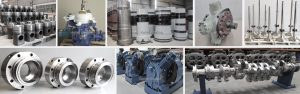
2. THE SHIP OF TOMORROW MAY CARRY A DIGITAL SPARE-PART WAREHOUSE
One of the greatest challenges in shipping is the management of spare parts.
A vessel can require thousands of components during its operational life. Many parts are rarely used, yet they must be available because failure could result in significant downtime.
The conventional response is physical inventory.
But what if selected parts could instead be stored as validated digital files?
A future maritime digital inventory could contain:
Part number → 3D scan → CAD model → material → manufacturing process → simulation → qualification → inspection data → certification → revision history.
The physical component would only be manufactured when required.
This could be particularly valuable for:
- Obsolete components
- Low-volume components
- Long-lead-time components
- Custom components
- Specialised maintenance parts
- Components for older vessels
- Components difficult to source internationally
The concept transforms the meaning of a spare part.
A spare part no longer has to exist only as a physical object.
It can also exist as a controlled digital asset.
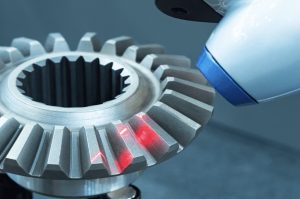
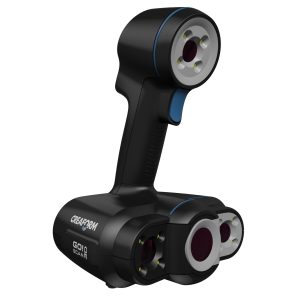
3. 3D SCANNING: CAPTURING THE KNOWLEDGE INSIDE EXISTING SHIPS
Thousands of components in the maritime world were designed before today’s digital engineering environment existed.
Some may have only paper drawings.
Others may have incomplete drawings.
Some may have no drawings at all.
A 3D scanner can capture the physical geometry of the existing component.
The process can become:
Physical Part → 3D Scan → Point Cloud → Reverse Engineering → CAD Model → Simulation → Validation → Digital Inventory
This can be especially powerful during:
- Ship refits
- Dry-docking
- Repairs
- Submarine maintenance
- Machinery overhauls
- Offshore inspections
- Shipyard modernisation
The objective is not merely to make a digital image.
It is to create an engineering-quality digital representation that can potentially become the starting point for manufacturing.
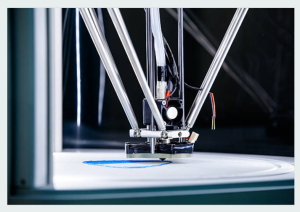
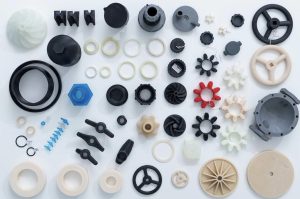
4. POLYMER 3D PRINTING: THE FIRST STEP TOWARDS ON-DEMAND MARINE MANUFACTURING
Not every marine component needs to be metallic.
There are hundreds of potential polymer applications across a vessel.
Depending on the engineering and regulatory requirements, these may include:
- Covers
- Brackets
- Cable-management components
- Protective housings
- Instrument enclosures
- Clips
- Handles
- Knobs
- Spacers
- Ventilation components
- Pipe supports
- Tooling
- Jigs and fixtures
- Maintenance aids
- Training models
- Non-critical interior components
High-performance polymers and reinforced materials can expand the application envelope.
But marine environments impose demanding requirements.
Saltwater, vibration, temperature, chemicals, fire and smoke requirements and mechanical loads all have to be considered.
Therefore:
A part should never be qualified merely because it can be printed.
It should be evaluated according to its intended application.
The U.S. Navy’s experience is instructive: polymer additive manufacturing has been deployed aboard vessels for approved technical-data packages and onboard maintenance requirements.
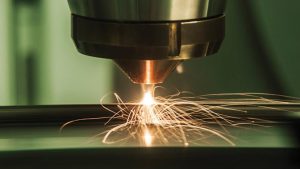
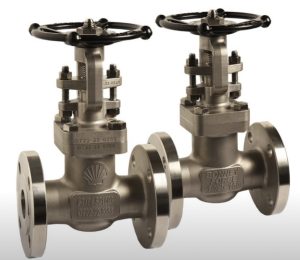
5. METAL 3D PRINTING: FROM VALVES TO COMPLEX ENGINEERING PARTS
The next major opportunity lies in metal additive manufacturing.
Marine engineering offers a compelling environment for AM because many components are:
- Complex
- Expensive
- Low-volume
- Difficult to procure
- Long-lead-time
- Tooling-intensive
Potential applications can include:
Valves
Valve bodies, components and specialised configurations.
Pumps
Impellers and selected pump components.
Piping
Specialised fittings, manifolds and connectors.
Machinery
Brackets, housings and specialised components.
Propulsion
Selected components subject to appropriate qualification.
Tooling
Manufacturing and maintenance tooling.
Repair
Material addition to worn components.
The U.S. Navy’s experience provides an indication of the direction of travel. In 2025, it reported installation of a large metal AM valve manifold on a nuclear-powered aircraft carrier and a metal 3D-printed component on a Virginia-class submarine.
This demonstrates a transition:
From “Can we print it?” to “Can we qualify and deploy it?”
That is the much more important question.
6. SUBMARINES: WHERE ADDITIVE MANUFACTURING COULD HAVE EXCEPTIONAL VALUE
Submarine engineering represents one of the most demanding applications for advanced manufacturing.
The number of submarines in a fleet is relatively small compared with merchant vessels.
Consequently, conventional tooling economics can become challenging.
A component may require:
Special mould → pattern → casting → machining → finishing → inspection.
For only a limited number of components, the cost and time associated with this conventional process can become significant.
AM offers another route:
Digital model → Simulation → Additive manufacturing → Post-processing → Metrology → Qualification.
This can be especially attractive for specialised components and legacy parts.
The U.S. Navy’s submarine AM programme demonstrates the strategic importance being placed on this capability. Navy officials have described AM as a potential means of addressing submarine sustainment challenges and have reported permanently installed AM parts on submarines.
But submarines also make one point absolutely clear:
AM adoption must be accompanied by rigorous material, process, inspection and certification regimes.
“For submarines, the question cannot simply be whether a part can be printed. The real question is whether the complete digital-to-physical manufacturing chain can produce a part with predictable, repeatable and certifiable performance.”
— Cmde. Niranjan Khardenavis (Retd.)
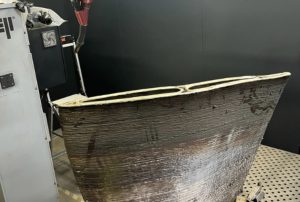
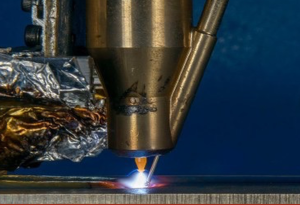
7. DIRECT ENERGY DEPOSITION: GIVE EXISTING PARTS A SECOND LIFE
Perhaps the most important technology for Green Shipbuilding is not manufacturing a new component.
It is repairing an existing one.
Direct Energy Deposition provides an important pathway.
The principle is straightforward:
Scan → Identify damage → Deposit material → Machine → Inspect → Requalify.
Instead of discarding a valuable component because one surface has worn or been damaged, material can potentially be deposited precisely where required.
Potential applications include:
- Shafts
- Sleeves
- Valve seats
- Pump components
- Impellers
- Large tooling
- Erosion-damaged surfaces
- Corrosion-damaged surfaces
- High-value machine components
This creates a new philosophy:
Repair rather than replace.
Reclaim rather than discard.
Extend rather than consume.
This is the essence of circular manufacturing.
8. GREEN SHIPBUILDING: MAKE LESS, STORE LESS, WASTE LESS
Green shipbuilding should not be restricted to propulsion efficiency.
The entire lifecycle of a component must be considered.
Conventional manufacturing can involve:
- Excess material
- Machining waste
- Tooling
- Patterns
- Casting waste
- Transportation
- Packaging
- Large inventories
- Obsolescence
A digital manufacturing ecosystem can potentially address these challenges.
Make less
Produce only what is required.
Store less
Maintain digital inventories for suitable low-demand components.
Transport less
Manufacture closer to the point of need where approved infrastructure exists.
Waste less
Use additive processes and repair technologies where appropriate.
Replace less
Reclaim components through DED.
This makes additive manufacturing an important technology in the transition towards a Circular Maritime Economy.
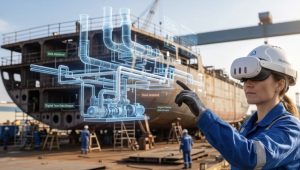
9. 3D VISUALISATION TAKES DIGITALISATION BEYOND INDIVIDUAL PARTS.
A complete vessel can potentially be represented digitally.
The digital environment can contain:
- Hull
- Machinery
- Piping
- Valves
- Electrical systems
- Engines
- Pumps
- Navigation systems
- Accommodation
- Safety systems
The same principle can apply to:
- Submarines
- Oil rigs
- Offshore platforms
- Ports
- Shipyards
- Marine operational centres
Engineers can visualise complex environments before physical intervention.
Maintenance teams can understand equipment relationships.
Training teams can create immersive learning environments.
Management can visualise asset condition and maintenance priorities.
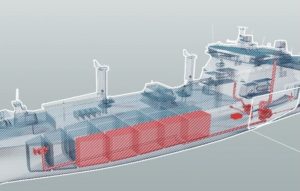
10. FROM 3D MODEL TO AI-ENABLED DIGITAL TWIN
A 3D model shows what an asset is.
A Digital Twin can increasingly help show what the asset is doing.
This distinction is fundamental.
A Digital Twin can integrate:
3D Geometry + Sensors + IoT + Maintenance History + Simulation + Operational Data + AI.
Imagine a ship’s engine room represented digitally.
The Digital Twin could contain:
- Temperature
- Pressure
- Vibration
- Flow
- RPM
- Fuel consumption
- Maintenance history
- Component age
- Inspection records
- Repair history
AI can analyse the information and identify emerging patterns.
The future maintenance question becomes:
Not: “When did the component fail?”
But: “What evidence indicates that the component is approaching failure?”
This is the transition from:
Reactive Maintenance → Preventive Maintenance → Predictive Maintenance → Prescriptive Maintenance.
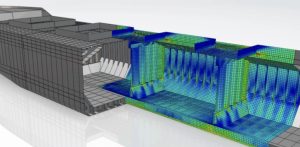
11. SIMULATION + METROLOGY: VALIDATE BEFORE AND AFTER MANUFACTURING
A digitally manufactured component must pass two fundamental tests.
Before manufacturing:
Will the design perform as intended?
After manufacturing:
Did we actually manufacture what we designed?
3D Simulation addresses the first question.
It can evaluate:
- Structural strength
- Stress
- Thermal behaviour
- Fatigue
- Vibration
- Fluid flow
- Pressure
- Deformation
- Manufacturing distortion
3D Metrology addresses the second.
The manufactured component can be compared with its approved digital model.
CAD Model ↔ Printed Part
This can identify:
- Dimensional variation
- Distortion
- Warpage
- Surface deviations
- Geometric inaccuracies
The final inspection record can become part of the component’s digital technical file.
This is essential for creating trust in digital manufacturing.
12. THE DIGITAL TWIN OF A SHIP: THE ULTIMATE MARITIME DIGITAL ASSET
The ultimate goal is not a digital spare part.
It is a Digital Twin of the entire maritime asset.
Imagine a future where a ship’s digital twin contains:
Design Data
Original engineering information.
Manufacturing Data
How components were manufactured.
Inspection Data
What was measured.
Operational Data
How the ship is performing.
Maintenance Data
What has been repaired or replaced.
AM Data
Which components can be digitally manufactured.
Simulation Data
How systems behave under different conditions.
AI Analytics
What is likely to happen next.
This creates a continuously evolving digital engineering record.
For an offshore platform, it could include structural condition.
For an oil rig, equipment performance.
For a submarine, machinery and component status.
For a shipyard, the complete production environment.
For a fleet, multiple connected asset twins.
13. THE MARITIME DIGITAL WAREHOUSE
The concept of a Digital Warehouse deserves particular attention.
A shipping company could maintain a secure repository of validated digital components.
Each part could have:
- Unique identification
- CAD model
- Material specification
- Approved process
- Machine requirements
- Simulation results
- Inspection procedure
- Certification status
- Revision control
- Supplier/manufacturer information
When a component is needed, the organisation can determine whether it should be:
Purchased → Machined → Printed → Repaired → Reclaimed.
This could fundamentally change maritime logistics.
The warehouse becomes partly physical and partly digital.
Physical Inventory + Digital Inventory = Intelligent Maritime Inventory
14. A NEW GENERATION OF MARITIME ENGINEERS
Technology will only transform the maritime sector if people are trained to use it.
The marine engineer of the future may need to understand:
- CAD
- 3D Scanning
- Reverse Engineering
- Additive Manufacturing
- Advanced Materials
- Simulation
- Metrology
- Digital Twins
- AI
- IoT
- Data Analytics
- Robotics
- Digital Manufacturing
- Cybersecurity
This is not about replacing traditional marine engineering.
It is about adding a powerful digital layer to it.
The result will be new career opportunities:
Maritime Additive Manufacturing Engineer
Marine Digital Twin Engineer
Marine 3D Metrology Specialist
Maritime Reverse Engineering Specialist
Digital Spare-Part Engineer
AM Materials Specialist
Marine Simulation Engineer
AI-Enabled Predictive Maintenance Engineer
Digital Shipyard Engineer
Maritime AM Certification Specialist
These are the skills that can support India’s next generation of maritime industry.
15. INDIAN MARITIME UNIVERSITY CAN BECOME A NATIONAL CATALYST
The Indian Maritime University is uniquely positioned to lead this transformation.
IMU is already moving in the direction of experiential digital maritime education.
In August 2026, its I-SEAS initiative conducted a two-day hands-on programme on CAD Modelling, Reverse Engineering & 3D Printing Techniques for Marine Applications, giving 52 students practical exposure to digital design, reverse engineering, additive manufacturing and rapid prototyping.
This is an important beginning.
But the opportunity is much larger.
India should establish a dedicated Centre for 3D Maritime Manufacturing, Visualisation & AI-Enabled Digital Twins at IMU.
The Centre could bring together:
3D Printing Laboratory
Polymer, composite and metal AM.
3D Scanning & Reverse Engineering Laboratory
Industrial scanning and CAD reconstruction.
DED Repair & Reclamation Laboratory
Marine component repair.
Simulation Centre
FEA, CFD, thermal and manufacturing simulation.
3D Metrology Centre
Dimensional inspection and validation.
Digital Twin Centre
AI, IoT and asset intelligence.
Marine Materials Centre
Advanced polymers, composites and metals.
Digital Maritime Inventory Centre
Digital spare-part libraries.
Industry Skill Development Centre
Training for marine engineers and shipyard professionals.
Standards & Certification Research Centre
Qualification methodologies and maritime AM standards.
16. INDIA NEEDS A NATIONAL DIGITAL MARITIME SPARE-PART INITIATIVE
A pilot programme could begin with selected ships.
The workflow could be:
Identify high-value/obsolete/low-volume parts
↓
3D Scan
↓
Reverse Engineer
↓
Create CAD
↓
Simulate
↓
Manufacture
↓
Inspect
↓
Test
↓
Qualify
↓
Digitally Store
↓
Manufacture on Demand
Such a programme could involve:
- IMU
- Indian shipyards
- Naval organisations
- Marine equipment manufacturers
- Classification societies
- Research institutions
- 3D technology companies
- Startups
- Material companies
This would establish the foundations of an Indian Digital Maritime Supply Chain.
17. THE FUTURE SHIPYARD WILL BE CYBER-PHYSICAL
The shipyard of the future will not simply be a place where steel is cut and welded.
It will be a cyber-physical manufacturing environment.
It could combine:
3D Scanning
Digital Engineering
AI
Robotics
Metal AM
Polymer AM
DED
CNC
Automated Inspection
Digital Twins
Simulation
Connected Manufacturing Data
The physical shipyard and its digital counterpart will continuously interact.
The result could be:
- Faster engineering
- Reduced rework
- Better quality
- Improved traceability
- Faster maintenance
- Reduced inventory
- Better asset management
18. MARINE DEFENCE: TECHNOLOGY MEETS STRATEGIC SELF-RELIANCE
For defence, the implications extend beyond cost.
They include:
Availability
A vessel that spends less time waiting for a component can return to operational duty faster.
Supply-Chain Resilience
On-demand manufacturing can reduce dependence on long and vulnerable supply chains for suitable qualified parts.
Obsolescence Management
Legacy components can potentially be recreated from validated digital information.
Indigenisation
Indian industry can develop capabilities to manufacture specialised components domestically.
Operational Flexibility
Selected qualified components could potentially be manufactured closer to the point of need.
The U.S. Navy has explicitly linked additive manufacturing to readiness, supply-chain resilience and frontline fleet operations. In 2025, it reported a 70% reduction in lead time in one AM application and the installation of AM components on both surface and submarine platforms.
India can learn from such programmes while developing its own qualification, security and certification architecture.
19. THE MOST IMPORTANT WORD: QUALIFICATION
Technology must never outrun safety.
A marine AM component cannot simply be printed and installed because its dimensions appear correct.
The complete chain must be controlled.
Material Qualification
Is the material suitable?
Machine Qualification
Can the machine repeatedly produce the required properties?
Process Qualification
Is the process stable?
Operator Qualification
Is the operator competent?
Part Qualification
Does the specific component meet its requirements?
Inspection
Does it conform geometrically and materially?
Testing
Does it perform under required conditions?
Certification
Can it be approved for its intended service?
This must be particularly rigorous for:
- Pressure systems
- Propulsion
- Structural components
- Life-support systems
- Safety-critical valves
- Submarine components
- Defence systems
The U.S. Navy’s current work on process-material specifications for AM qualification demonstrates the importance of building this certification architecture alongside manufacturing capability.
20. THE FINAL VISION: A SMART, GREEN AND SELF-RELIANT MARITIME INDIA
The maritime sector is standing at the intersection of several technological revolutions.
3D Printing
Manufacture components.
3D Scanning
Capture physical components.
Reverse Engineering
Recover engineering knowledge.
3D Simulation
Predict performance.
3D Metrology
Validate manufacturing.
DED
Repair and reclaim.
3D Visualisation
Understand complex assets.
Advanced Materials
Expand application possibilities.
AI
Add intelligence.
Digital Twins
Connect the physical and digital worlds.
Together, these technologies create something much bigger than additive manufacturing.
They create a Digital Maritime Engineering Ecosystem.
THE BIG IDEA
“The maritime industry should begin thinking of every important component as having two identities: a physical identity and a digital identity. The physical part operates on the ship; the digital part carries its engineering knowledge, manufacturing information, inspection history and lifecycle intelligence.”
— Dr. Shibu John
Managing Editor & Founder, 3D GRAPHY NEWS
Founder & CEO, 3D GRAPHY LLP
FROM PHYSICAL SPARES TO DIGITAL SPARES
The maritime industry has traditionally asked:
How many spare parts should we keep?
The digital maritime industry will increasingly ask:
Which spare parts do we need to keep physically—and which can we manufacture on demand from validated digital inventories?
That is a fundamental change.
FROM REPLACEMENT TO RECLAMATION
The traditional maintenance mindset says:
Worn part → Replace.
The advanced manufacturing mindset asks:
Can we scan it, repair it, reclaim it and return it to service?
DED provides a pathway towards this model.
FROM REACTIVE TO PREDICTIVE
The old model:
Failure → Repair.
The new model:
Monitor → Analyse → Predict → Plan → Maintain.
AI-enabled Digital Twins make this possible.
FROM SHIPBUILDING TO DIGITAL SHIPBUILDING
The future shipyard will increasingly combine physical manufacturing with digital intelligence.
The ship will have a digital twin.
Its components will have digital records.
Its selected spare parts will have digital manufacturing files.
Its maintenance history will become part of its digital lifecycle.
Its operational data will continuously update its digital representation.
A CALL TO ACTION FOR INDIA
India now has the opportunity to build this capability at scale.
The country should establish a coordinated maritime programme bringing together:
Government + IMU + Indian Navy + Shipyards + Maritime Industry + Classification Societies + Technology Companies + Startups + Academia + Research Institutions.
The objective should be to create an Indian capability covering:
Scan
Digitise
Design
Simulate
Repair
Inspect
Certify
Monitor
Predict
Maintain
Optimise
This can create a new generation of maritime engineering capabilities and employment.
THE MARITIME TECHNOLOGY TRANSFORMATION HAS ALREADY BEGUN
The evidence is no longer confined to laboratories.
IMU is providing students with hands-on exposure to marine CAD, reverse engineering and 3D printing.
The U.S. Navy has moved AM into operational ship and submarine environments, including metal and polymer systems.
The submarine domain is exploring AM for sustainment and qualified components.
The direction is clear.
The challenge for India is now to build an ecosystem that is indigenous, qualified, scalable, secure and commercially viable.
CONCLUSION
THE SHIP OF THE FUTURE WILL HAVE A DIGITAL SOUL
The transformation of marine engineering will not happen because of a single 3D printer.
It will happen when the maritime industry learns to connect the entire lifecycle of an asset.
A component can be scanned.
Its digital model can be created.
Its performance can be simulated.
Its material can be selected.
It can be manufactured through additive manufacturing.
Its dimensions can be validated through metrology.
It can be certified.
It can be installed.
Its performance can be monitored.
Its Digital Twin can record its lifecycle.
When it wears out, it may be repaired through DED.
When it finally reaches the end of its life, its knowledge can remain in the digital ecosystem.
That is the real promise of digital maritime engineering.
“We are moving towards a maritime environment where the physical ship and its digital twin will increasingly operate as one engineering ecosystem. 3D technology will provide the bridge between the physical component and the digital asset, while AI will provide the intelligence to understand, predict and optimise the lifecycle.”
— Cmde. Niranjan Khardenavis (Retd.)
Director – Marine & Defence, 3D GRAPHY LLP
Special Correspondent – Marine & Defence, 3D GRAPHY NEWS
And the strategic vision is equally compelling:
“India should not wait for the digital maritime revolution to mature elsewhere. We should build our own ecosystem—from maritime education and digital inventories to additive manufacturing, repair, certification and AI-enabled Digital Twins. This can become a major pillar of India’s maritime self-reliance and create an entirely new generation of skilled employment.”
— Dr. Shibu John
Managing Editor & Founder, 3D GRAPHY NEWS
Founder & CEO, 3D GRAPHY LLP
The opportunity before India is therefore not simply to adopt 3D Printing.
It is to reimagine the entire maritime engineering lifecycle.
From Physical to Digital.
From Replacement to Reclamation.
From Inventory to Digital Inventory.
From Reactive to Predictive.
From Conventional Shipbuilding to Green Digital Shipbuilding.
From Isolated Technologies to AI-Enabled Digital Twins.
From Technology Adoption to Maritime Technology Leadership.
The future ship will not only sail with engines, machinery and equipment.
It will sail with a digital twin, a digital inventory and an intelligent engineering ecosystem behind it.
ABOUT THE AUTHOR
Cmde. Niranjan Khardenavis (Retd.)
Director – Marine & Defence, 3D GRAPHY LLP
Special Correspondent – Marine & Defence, 3D GRAPHY NEWS
With a distinguished background in the Indian Navy and a focus on the convergence of maritime engineering and emerging 3D technologies, Cmde. Khardenavis contributes strategic perspectives on additive manufacturing, digital manufacturing, shipbuilding, submarine engineering, marine maintenance, defence technology and maritime digital transformation.
ABOUT 3D GRAPHY NEWS
3D GRAPHY NEWS is a specialised technology media platform covering the rapidly evolving ecosystem of 3D Printing, 3D Scanning, 3D Visualisation, 3D Simulation, Digital Twin, AI, advanced materials, engineering, healthcare, manufacturing, marine and defence technologies.
Its objective is to connect technology developments with industry adoption, education, research and India’s emerging technology ecosystem.