

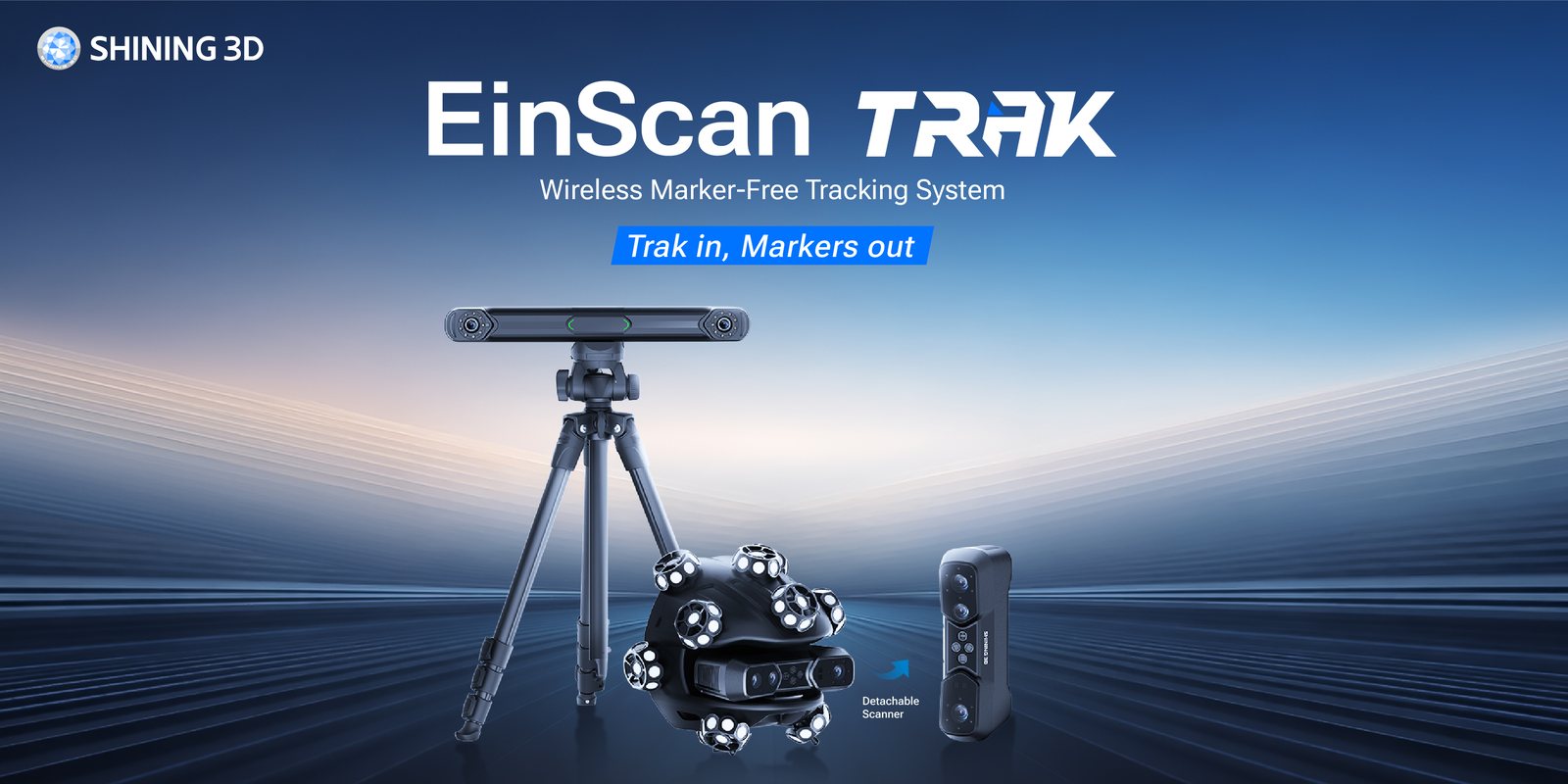
SHINING 3D has launched the EinScan Trak, a wireless tracking and scanning system whose spherical scanner splits open to release a standalone handheld laser scanner. Tracking mode needs no markers on the object at all, and handheld mode can work marker-free on feature-rich surfaces. It went on sale on August 19, 2026 at $6,999.
This article is sponsored by SHINING 3D. 3DPrinting.com received compensation for placement; editorial direction was led by 3DPrinting.com.
Large-object 3D scanning has usually meant a trade-off. Optical tracking systems cover big surfaces quickly but need a fixed setup and, in most cases, reflective markers stuck all over the part. Handheld scanners go anywhere but slow down on wide, featureless panels. Teams that need both have generally bought both, which is part of why the professional scanner market stays so segmented.
The EinScan Trak is SHINING 3D’s answer to that split. It pairs an optical tracker with a spherical scanner that works wirelessly inside the tracker’s volume, and the scanner module lifts out of that sphere to carry on as a handheld unit in the same project. SHINING 3D describes it as the first wireless, dual-form, marker-free tracking system, and markers come off the object in both modes rather than just one. One thing to be clear about before the detail: we have not had a Trak in our hands. Everything below is SHINING 3D’s own data.
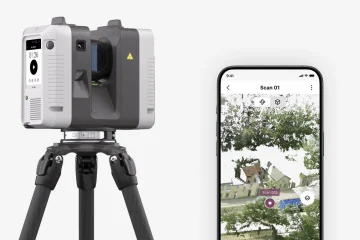
The EinScan Trak system: the optical tracker, the spherical scanner, and the handheld scanner that lifts out of it.
EinScan Trak: on sale now at $6,999
Launched August 19, 2026, shipping free from the official store. The box includes the tracker, both scanner forms, calibration kit, tripod, four batteries and a one-year EXMeasure license valued at $699.
Affiliate link: we may earn a commission at no extra cost to you.
The numbers that matter
Every figure below comes from SHINING 3D’s own specification sheet and product page for the Trak.
Two notes on the headline figures, both from SHINING 3D directly. The 0.1 mm volumetric accuracy applies to tracking mode only, measured against an internal standard developed in accordance with ISO 10360; the company does not quote an equivalent figure for handheld mode. And the resolution range is the one to read closely: 0.05 mm is the floor of what the hardware can resolve, not a setting you would run across a whole car.
One system, two work modes
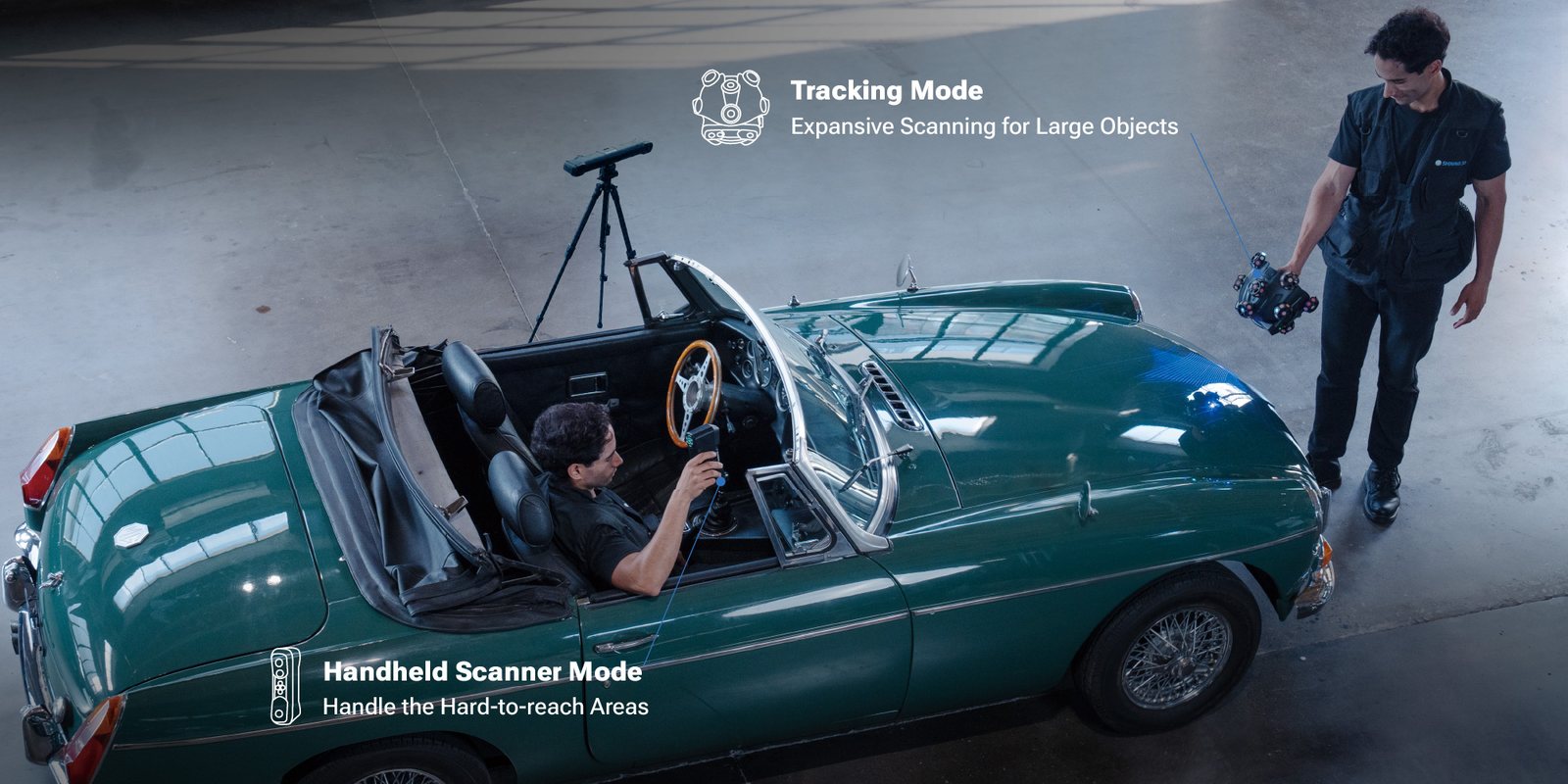
Tracking mode
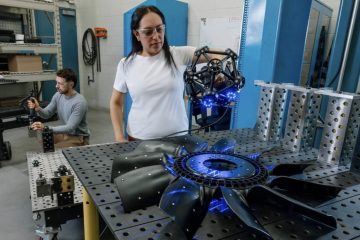
The spherical scanner talks to the tracker over Wi-Fi 6 while the tracker follows its pose, meaning its position and orientation in space, using the retroreflective markers on the scanner body. Because the tracking reference sits on the scanner rather than on the part, you are not depending on continuous surface features or on markers stuck to the object. That is what makes it workable on car bodies, aftermarket panels, speedboat hulls and yacht decks, where surfaces are wide, glossy and short on geometric detail.
The Hybrid Leapfrog function lets you reposition the tracker mid-scan and keep tracking, so the working envelope is not capped by a single tripod position. When the tracker moves, continuity is read from markers rather than from surface features, and the requirement is modest: four markers per station.
Handheld scanner mode
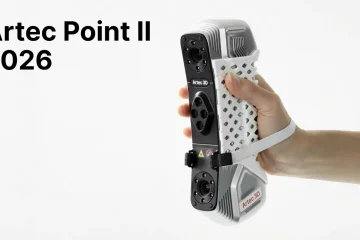
Release the scanner module from the sphere and it becomes a wireless handheld laser scanner with no tracker in the loop, so there is no setup to do and no line of sight to protect. This is the mode for deep cavities, narrow channels, engine bays, small mechanical parts and anything tucked behind an obstruction. The switch happens inside the same project group, so the final output is still a single project rather than two files to reconcile.
Inside the hardware
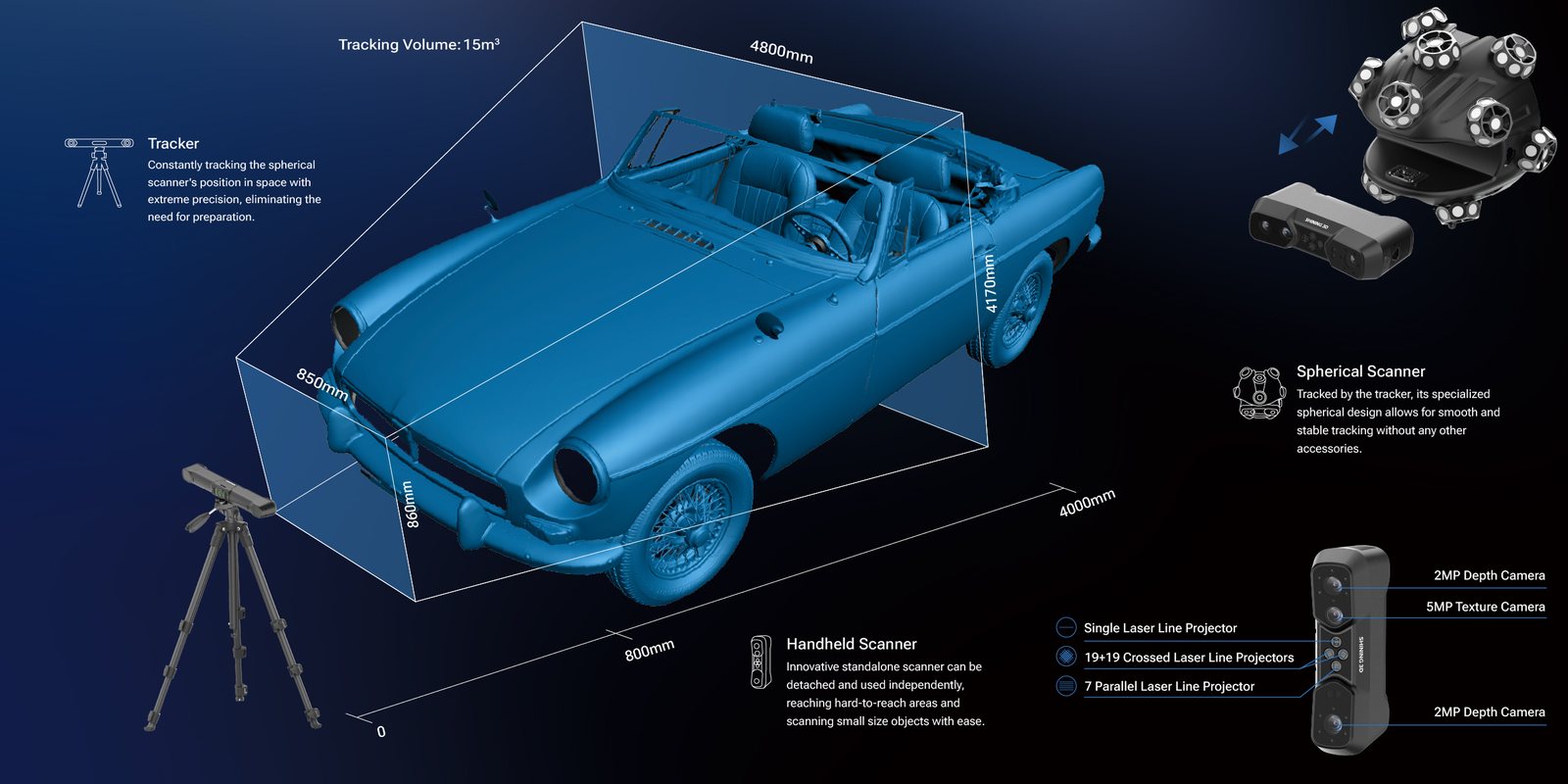
The scanner carries two 2MP depth cameras and a 5MP texture camera, capturing geometry and color in the same pass. The tracker adds two 5MP depth cameras of its own for pose tracking. Tracking volume is 15 m³, and the assembly is built from high-strength carbon fiber to keep field weight down.
Wireless operation runs over an independent LAN on a Wi-Fi 6 module that pairs automatically at startup, with a wired option if site conditions demand it. In tracking mode the tracker and the spherical scanner each run on two 5400 mAh batteries; the handheld scanner takes one. All of them are hot-swappable, which matters more on a long shop-floor session than the headline runtime does. Note the working geometry too: the scanner has to stay within the 4,000 mm tracking distance of the tracker, so this is a walk-around system rather than a roam-the-shop one.
Budget for the computer as well as the scanner. The minimum specification is an RTX 3060 laptop GPU with 6 GB of VRAM, 32 GB of DDR5 in dual channel, and an i7-13650HX or Ryzen 7 7735H, which is a current and not cheap mobile workstation. If your existing laptop is a generation or two back, that is a real line item on top of the quote.
Three blue laser modes
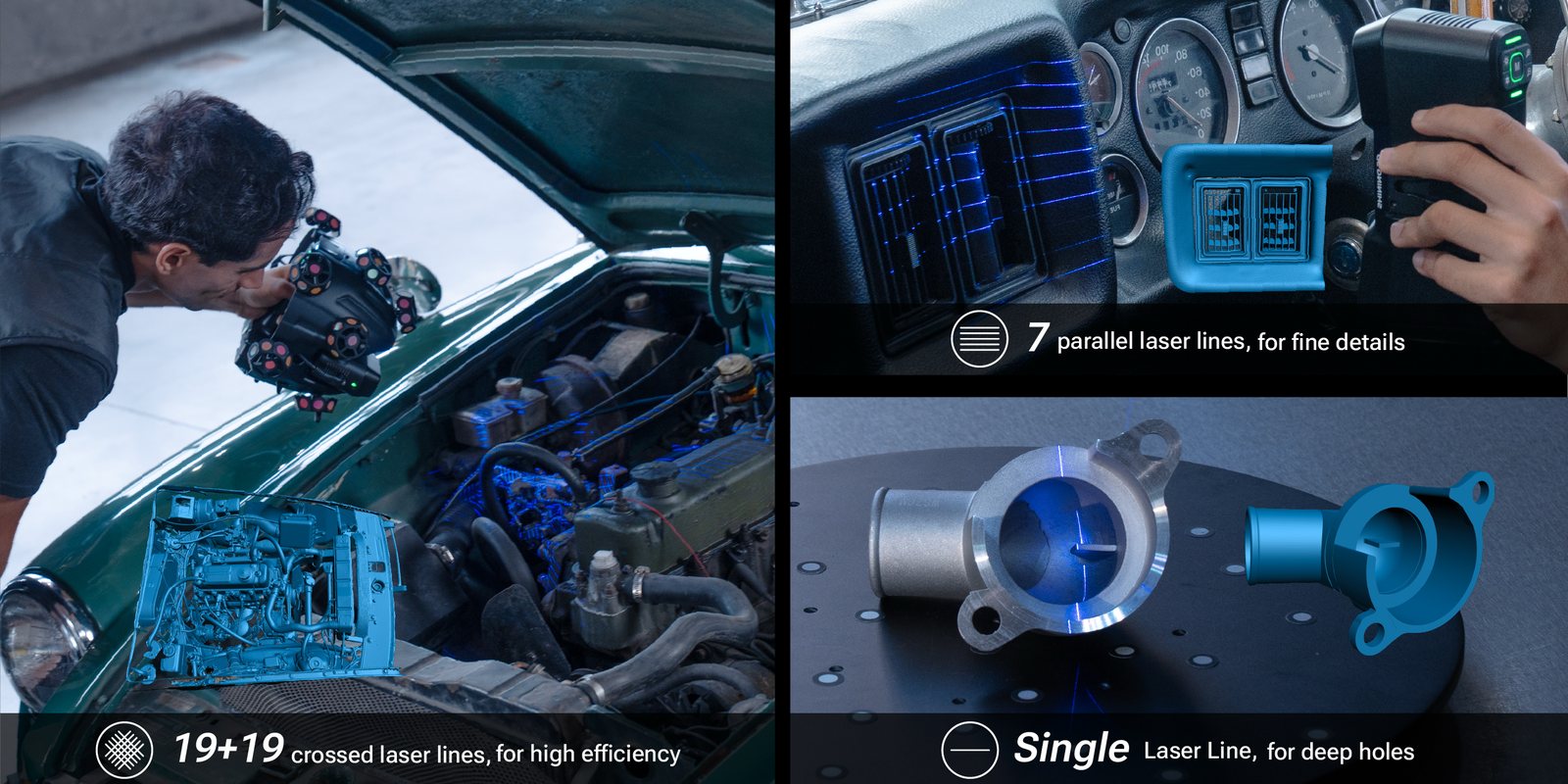
Rather than compromising with a single laser pattern for every job, the Trak switches between three.
Marker-free in both modes
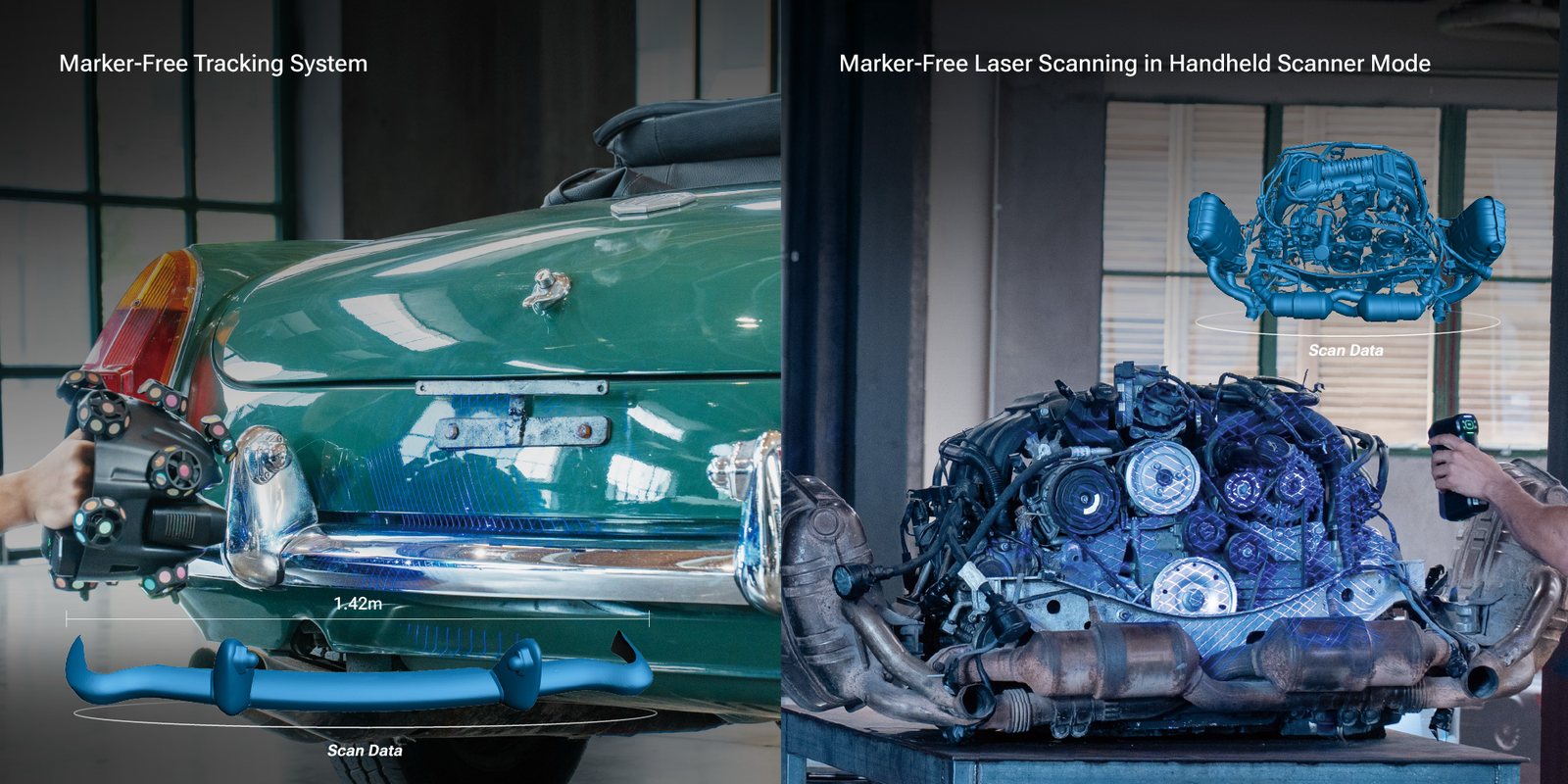
Marker placement is the part of a large scan nobody budgets enough time for, and on some jobs it is simply not allowed. Museum pieces, artworks and original-paint vehicles are not candidates for adhesive dots.
In tracking mode the marker-free tracking system handles it because the reference is on the scanner. In handheld mode, SHINING 3D’s laser marker-free technology tracks off the object’s own geometry, so parts with rich, non-repetitive features can be scanned straight away. Global markers, the stick-on reference dots normally used to lock a large scan together, stay available for jobs that need the tightest possible alignment, but they are now an option rather than a prerequisite.
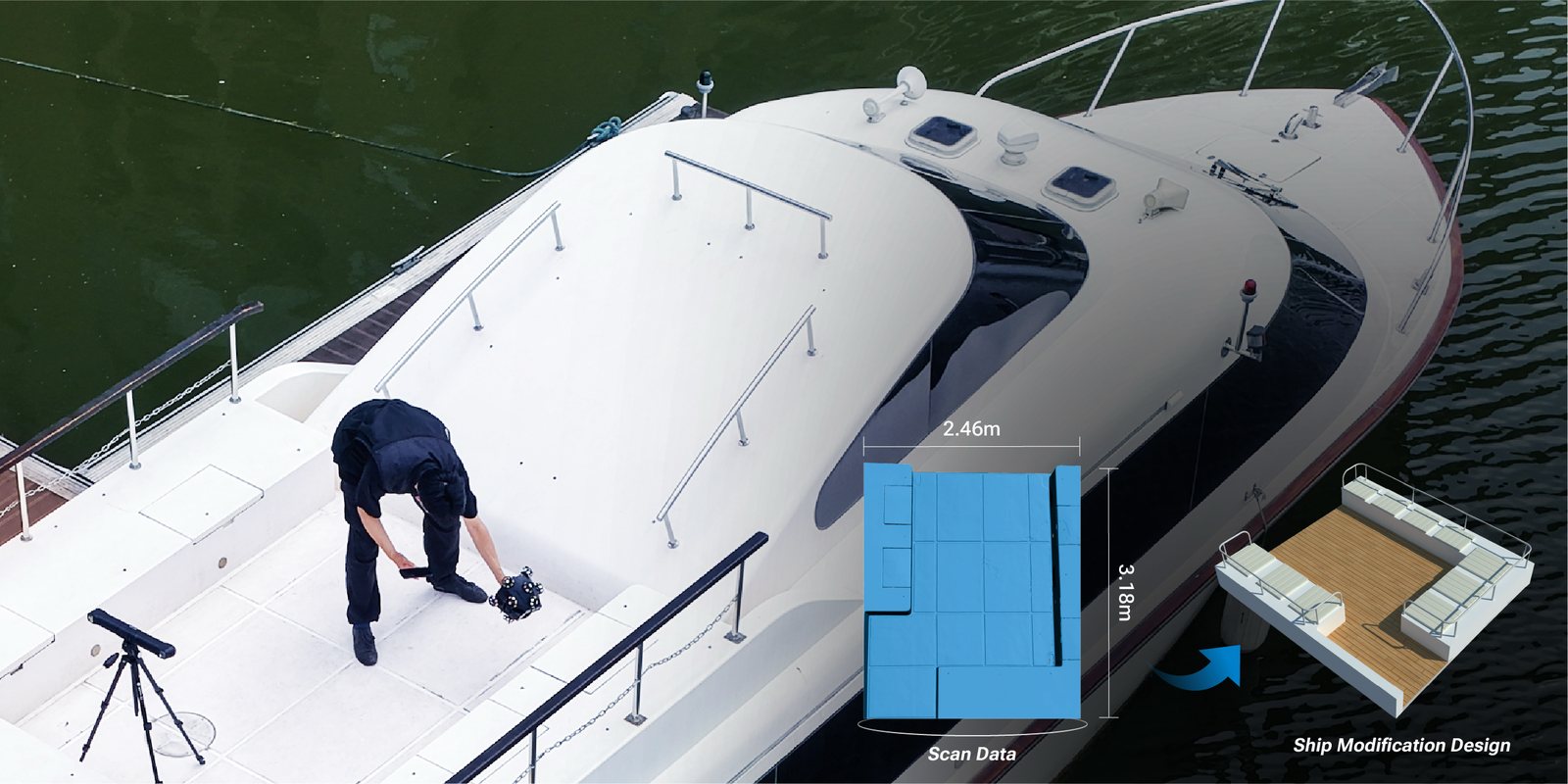
Scanning a yacht deck for a modification design, one of the large-format jobs tracking mode is aimed at.
Coarse and fine detail in one project
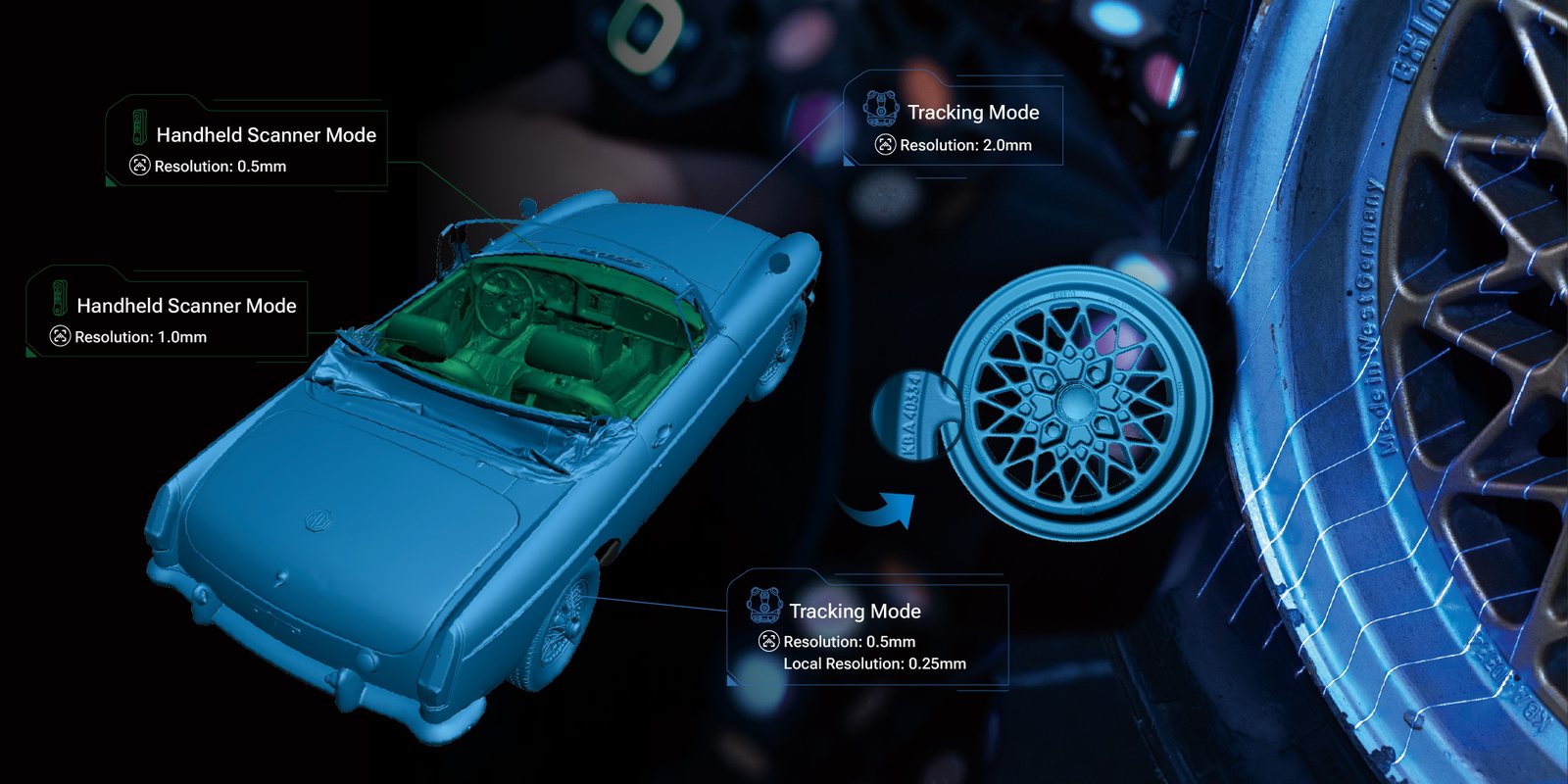
Resolution is not locked for the whole job. SHINING 3D’s own example runs a car body at 2.0 mm in tracking mode and drops Local Resolution to 0.25 mm on the areas that need it, with handheld passes at 0.5 mm to 1.0 mm for the interior and the wheels. Data from tracking mode and handheld mode merges within the project, across laser modes, so you end up with one model instead of a stack of partial meshes, and with less redundant data to clean up.
Black plastics, gloss paint, bare metal and alloy rims usually cost an afternoon of preparation. The Trak is built to capture them directly and cut down on matting spray. It also holds up outdoors in light up to 110,000 lux and works from -10°C to 40°C. One limit to note before you plan an outdoor job: the rating on the spec sheet is IP50, which covers dust but offers no water ingress protection at all, so rain and washdown stay the operator’s problem.
Color, not just geometry
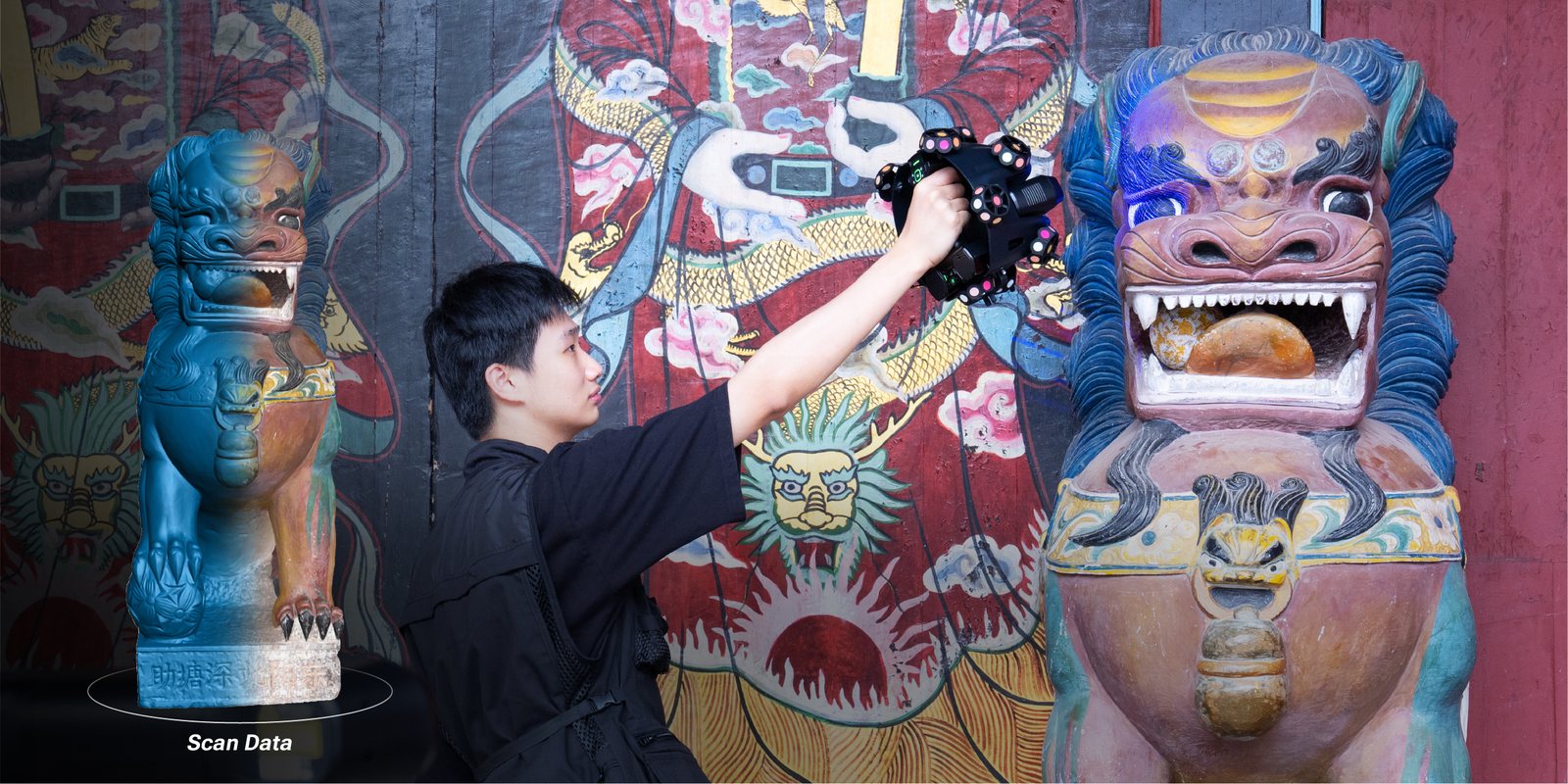
Laser tracking systems are bought for speed and measurement, rarely for texture. The 5MP texture camera changes the calculation here: alongside the geometry you get realistic color and material reproduction from the same capture. For museums, heritage documentation, research and digital archiving, that is the difference between a measurement and a record.
Software: EXScan, EXMeasure and EXModel
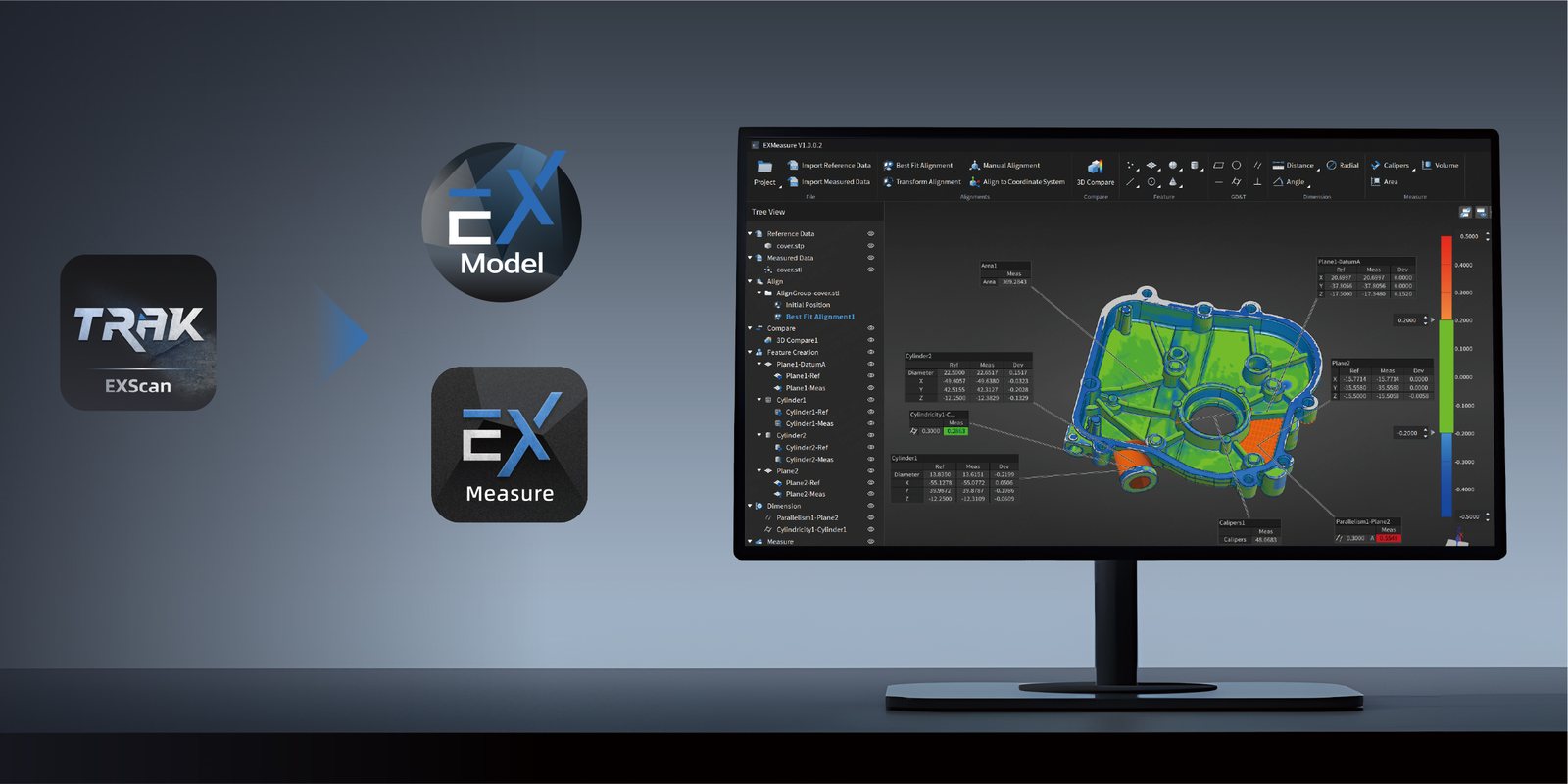
Capture runs in EXScan, which is included with the scanner at no additional cost, and the data feeds two downstream packages.
EXMeasure covers dimensional work: alignment against a reference model, feature creation from points, lines, planes and cylinders, one-click color deviation maps, and GD&T (geometric dimensioning and tolerancing) checks for flatness, parallelism and cylindricity. It also does the ordinary things, angle, area, volume and simulated caliper measurements, and exports visual reports, which is usually what quality sign-off actually needs.
EXModel handles the route to CAD: mesh editing, coordinate alignment, primitive extraction, cross sections, 2D and 3D sketching, free-form modeling, auto surfacing and feature-based reconstruction, with standard CAD export at the end. It is the bridge from scan mesh to editable, manufacturable geometry.
The licensing is straightforward. A one-year EXMeasure license, valued at $699, is included with every Trak; renewing after the first year costs $699 a year or $1,299 for three years. EXModel is sold separately, and it is one route to CAD rather than a required add-on: the Trak exports STL, OBJ, PLY, 3MF and ASC, so the scan can go into whichever CAD or reverse engineering package you already run.
Where the EinScan Trak fits
Pairing large-format coverage with marker-free detail capture points the Trak at a specific kind of shop: one that measures big things and small features in the same week.
- Automotive and customization: body panels, aftermarket parts, and restoration work on vehicles that cannot take markers.
- Marine: speedboat and yacht hulls, decks, and modification design.
- Reverse engineering: mechanical components, castings and legacy parts with no drawings.
- Part comparison and analysis: first-article checks and full-field deviation analysis through EXMeasure.
- Heritage and research: sculpture, artifacts and artworks where color matters and contact is out of the question.
- Digital content: AR, VR and asset creation that needs accurate geometry and true color together.
If you are weighing it against the wider market, our guide to the best 3D scanners for large objects puts systems like this in context.