

Advertise with us

3D GRAPHY NEWS

  • Home
  • Interviews
    • Text Interviews
    • video Interviews
  • R & D
  • Spotlight
    • Spotlight Text
    • Spotlight Videos
  • Medical
    • Medical Devices
    • Orthotics & Prosthetics
    • Pharma
    • Cardiology
    • Head & Neck
    • Neurology
    • Orthopaedics & Spine
    • Ayurveda
  • Dental
  • Engineering
    • Aerospace & Defence
    • Architecture & Construction
    • Marine & shipbuilding
    • Automotive
    • Energy
    • Heavy Industry
  • 3D Technologies
    • 3D Printing
    • 3D Scanning
    • 3D Software
    • 3D Simulation
    • 3D Design
    • 3D Visualisation
    • 3D Digital Twin
    • Artificial Intelligence
  • Materials
  • LifeStyle
    • Jewellery & Fashion
    • Gadgets
    • Pharma & Food
    • Art & Entertainment
  • About Us
    • About Us
    • Editors Desk
    • 3D Expert Desk
    • End users desk
    • Advertise with us
    • contact-us
  • News & Events
First ads
Second ads
Home» 3D Printing»3D-printing platform rapidly produces complex electric machines

3D-printing platform rapidly produces complex electric machines

Dr. Shibu John Tue Aug 2026 3D Printing, Electronics, Engineering, Materials Comments Off on 3D-printing platform rapidly produces complex electric machines 13 Views

Facebook Twitter linkedin Pinterest WhatsAppt Telegram Viber More

Overcoming challenges of 3D printing with multiple functional materials, MIT researchers fabricated an electric linear motor in hours.

A broken motor in an automated machine can bring production on a busy factory floor to a halt. If engineers can’t find a replacement part, they may have to order one from a distributor hundreds of miles away, leading to costly production delays.

It would be easier, faster, and cheaper to make a new motor onsite, but fabricating electric machines typically requires specialized equipment and complicated processes, which restricts production to a few manufacturing centers.

In an effort to democratize the manufacturing of complex devices, MIT researchers have developed a multimaterial 3D-printing platform that could be used to fully print electric machines in a single step.

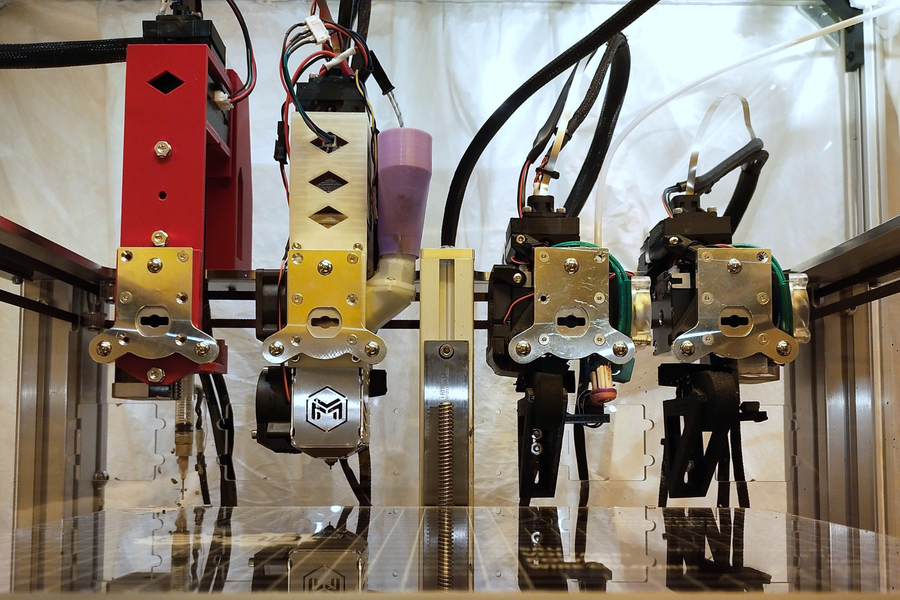
They designed their system to process multiple functional materials, including electrically conductive materials and magnetic materials, using four extrusion tools that can handle varied forms of printable material. The printer switches between extruders, which deposit material by squeezing it through a nozzle as it fabricates a device one layer at a time.

The researchers used this system to produce a fully 3D-printed electric linear motor in a matter of hours using five materials. They only needed to perform one post-processing step for the motor to be fully functional.

The assembled device performed as well or better than similar motors that require more complex fabrication methods or additional post-processing steps.

In the long run, this 3D printing platform could be used to rapidly fabricate customizable electronic components for robots, vehicles, or medical equipment with much less waste.

“This is a great feat, but it is just the beginning. We have an opportunity to fundamentally change the way things are made by making hardware onsite in one step, rather than relying on a global supply chain. With this demonstration, we’ve shown that this is feasible,” says Luis Fernando Velásquez-García, a principal research scientist in MIT’s Microsystems Technology Laboratories (MTL) and senior author of a paper describing the 3D-printing platform, which appears today in Virtual and Physical Prototyping.

He is joined on the paper by electrical engineering and computer science (EECS) graduate students Jorge Cañada, who is the lead author, and Zoey Bigelow.

More materials

The researchers focused on extrusion 3D printing, a tried-and-true method that involves squirting material through a nozzle to fabricate an object one layer at a time.

To fabricate an electric machine, the researchers needed to be able to switch between multiple materials that offer different functionalities. For instance, the device would need an electrically conductive material to carry electric current and hard magnetic materials to generate magnetic fields for efficient energy conversion.

Most multimaterial extrusion 3D printing systems can only switch between two materials that come in the same form, such as filament or pellets, so the researchers had to design their own. They retrofit an existing printer with four extruders that can each handle a different form of feedstock.

They carefully designed each extruder to balance the requirements and limitations of the material. For instance, the electrically conductive material must be able to harden without the use of too much heat or UV light because this can degrade the dielectric material.

At the same time, the best-performing electrically conductive materials come in the form of inks which are extruded using a pressure system. This process has vastly different requirements than standard extruders that use heated nozzles to squirt melted filament or pellets.

“There were significant engineering challenges. We had to figure out how to marry together many different expressions of the same printing method — extrusion — seamlessly into one platform,” Velásquez-García says.

The researchers utilized strategically placed sensors and a novel control framework so each tool is picked up and put down consistently by the platform’s robotic arms, and so each nozzle moves precisely and predictably.

This ensures each layer of material lines up properly — even a slight misalignment can derail the performance of the finished machine.

Making a motor

After perfecting the printing platform, the researchers fabricated a linear motor, which generates straight-line motion (as opposed to a rotating motor, like the one in a car). Linear motors are used in applications like pick-and-place robotics, optical systems, and baggage conveyers.

They fabricated the motor in about three hours and only needed to magnetize the hard magnetic materials after printing to enable full functionality. The researchers estimate total material costs would be about 50 cents per device. Their 3D-printed motor was able to generate several times more actuation than a common type of linear engine that relies on complex hydraulic amplifiers.

“Even though we are excited by this engine and its performance, we are equally inspired because this is just an example of so many other things to come that could dramatically change how electronics are manufactured,” says Velásquez-García.

In the future, the researchers want to integrate the magnetization step into the multimaterial extrusion process, demonstrate the fabrication of fully 3D-printed rotary electrical motors, and add more tools to the platform to enable monolithic fabrication of more complex electronic devices.

This research is funded, in part, by Empiriko Corporation and the La Caixa Foundation.

Source : MIT News  | Adam Zewe

2026-08-25
Facebook Twitter linkedin Pinterest WhatsAppt Telegram Viber More

Authors

Posted by : Dr. Shibu John
Previous Article :

Autodesk for Small Business update: Making it more affordable to get started with Autodesk Flex

Related Articles

LLNL Team Prints Ceramic Waveguide Lasers By Direct Ink Writing

LLNL Team Prints Ceramic Waveguide Lasers By Direct Ink Writing

Dr. Shibu John Fri Aug 2026
iAM3D Unveils LPW Z2500, a Large-Format Multi-Axis Laser DED Platform for High-Performance Metal Manufacturing

iAM3D Unveils LPW Z2500, a Large-Format Multi-Axis Laser DED Platform for High-Performance Metal Manufacturing

Dr. Shibu John Thu Aug 2026
Stratasys and Limbitless Solutions Expand Ongoing Partnership Providing Access to 3D-Printed Prosthetics for Children

Stratasys and Limbitless Solutions Expand Ongoing Partnership Providing Access to 3D-Printed Prosthetics for Children

Dr. Shibu John Wed Aug 2026
Heidelberg Team Designs Recyclable Polymer for Light-Based 3D Printing

Heidelberg Team Designs Recyclable Polymer for Light-Based 3D Printing

Dr. Shibu John Wed Aug 2026
European Researchers 3D Print Glass-like Metallic Components for More Efficient Electric Motors

European Researchers 3D Print Glass-like Metallic Components for More Efficient Electric Motors

Dr. Shibu John Wed Aug 2026
seco
first

Recent Posts

3D-printing platform rapidly produces complex electric machines
3D Printing

3D-printing platform rapidly produces complex electric machines

Dr. Shibu John Tue Aug 2026
iAM3D Unveils LPW Z2500, a Large-Format Multi-Axis Laser DED Platform for High-Performance Metal Manufacturing
3D Printing

iAM3D Unveils LPW Z2500, a Large-Format Multi-Axis Laser DED Platform for High-Performance Metal Manufacturing

Dr. Shibu John Thu Aug 2026
Stratasys and Limbitless Solutions Expand Ongoing Partnership Providing Access to 3D-Printed Prosthetics for Children
3D Printing

Stratasys and Limbitless Solutions Expand Ongoing Partnership Providing Access to 3D-Printed Prosthetics for Children

Dr. Shibu John Wed Aug 2026
Heidelberg Team Designs Recyclable Polymer for Light-Based 3D Printing
3D Printing

Heidelberg Team Designs Recyclable Polymer for Light-Based 3D Printing

Dr. Shibu John Wed Aug 2026
European Researchers 3D Print Glass-like Metallic Components for More Efficient Electric Motors
3D Printing

European Researchers 3D Print Glass-like Metallic Components for More Efficient Electric Motors

Dr. Shibu John Wed Aug 2026
3D Systems Receives $9 Million Contract Award from U.S. Air Force for Advanced Large-Format Metal 3D Printing System
3D Printing

3D Systems Receives $9 Million Contract Award from U.S. Air Force for Advanced Large-Format Metal 3D Printing System

Dr. Shibu John Wed Aug 2026
MIT turns pine-cone mechanics into 3D-printable adaptive materials
3D Printing

MIT turns pine-cone mechanics into 3D-printable adaptive materials

Dr. Shibu John Wed Aug 2026
Tel Aviv Team Creates Bioactive Ink for Precise 3D Printing
3D Printing

Tel Aviv Team Creates Bioactive Ink for Precise 3D Printing

Dr. Shibu John Wed Aug 2026
EPFL 3D-prints tiny drones that fly on sound alone
3D Printing

EPFL 3D-prints tiny drones that fly on sound alone

Dr. Shibu John Sun Aug 2026
Notre Dame researchers 3D print blood capillaries smaller than a human hair
3D Printing

Notre Dame researchers 3D print blood capillaries smaller than a human hair

Dr. Shibu John Sun Aug 2026
3D Printed Coral-Inspired Scaffold Reprograms Immune Cells to Heal Bone Disease
3D Printing

3D Printed Coral-Inspired Scaffold Reprograms Immune Cells to Heal Bone Disease

Dr. Shibu John Sun Aug 2026

Advertisement

Advertisement


htmagazine
3D Graphy news is a information source for 3D Printing and 3d visualisation business

Follow us

Newsletter Subscription

Recent Posts

  • 3D-printing platform rapidly produces complex electric machines

    3D-printing platform rapidly produces complex electric machines

    Dr. Shibu John Tue Aug 2026
  • Autodesk for Small Business update: Making it more affordable to get started with Autodesk Flex

    Autodesk for Small Business update: Making it more affordable to get started with Autodesk Flex

    Dr. Shibu John Fri Aug 2026
  • LLNL Team Prints Ceramic Waveguide Lasers By Direct Ink Writing

    LLNL Team Prints Ceramic Waveguide Lasers By Direct Ink Writing

    Dr. Shibu John Fri Aug 2026

Random Posts

3D-printing platform rapidly produces complex electric machines

iAM3D Unveils LPW Z2500, a Large-Format Multi-Axis Laser DED Platform for High-Performance Metal Manufacturing

Stratasys and Limbitless Solutions Expand Ongoing Partnership Providing Access to 3D-Printed Prosthetics for Children

Heidelberg Team Designs Recyclable Polymer for Light-Based 3D Printing

European Researchers 3D Print Glass-like Metallic Components for More Efficient Electric Motors

3D Systems Receives $9 Million Contract Award from U.S. Air Force for Advanced Large-Format Metal 3D Printing System

MIT turns pine-cone mechanics into 3D-printable adaptive materials

Tel Aviv Team Creates Bioactive Ink for Precise 3D Printing

EPFL 3D-prints tiny drones that fly on sound alone

Notre Dame researchers 3D print blood capillaries smaller than a human hair

Advertise with us Join Our WhatsApp Group
© Copyright 2024-30, All Rights Reserved
Powered by 3D GRAPHY LLP